
The Wheelock-Occom Funding Dispute and 1769 Charter
The financial foundation of Dartmouth College rests on a documented act of misappropriation involving £12, 000 raised between 1766 and 1768. This sum, equivalent to millions in modern purchasing power, was collected specifically for the education of Native American youth. The architect of this fundraising campaign was not the college's founder, Eleazar Wheelock, his former student, Samson Occom. A Mohegan scholar and ordained Presbyterian minister, Occom served as the living proof of Wheelock's "Indian Charity School" concept. Without Occom's labor, the capital required to establish the institution in Hanover, New Hampshire, would not have existed.
Wheelock dispatched Occom to Great Britain to tour England and Scotland, where the Mohegan minister delivered over 300 sermons. Occom's intellect and oratory skills dismantled the prevailing European prejudice that Native Americans were incapable of "civilized" learning. His presence captivated high society, soliciting donations from King George III and the Earl of Dartmouth. The donors gave with the explicit understanding that their gold would fund a school for Indigenous students. Wheelock, remaining in Connecticut, orchestrated the accounts soon began to alter the mission.
The betrayal materialized in the 1769 Charter. While the document officially incorporated the college, it contained a legal loophole that allowed Wheelock to pivot the institution's purpose. The charter stated the college existed for the "education and instruction of youth of the Indian tribes in this land," yet it also included the phrase "and also of English youth and any others." Wheelock used this clause to redirect the British funds toward educating the sons of white settlers. He moved the school from Connecticut to the remote woodlands of Hanover, New Hampshire, a location far removed from the populous Native settlements Occom intended to serve.
Occom recognized the theft immediately upon his return. In a blistering 1771 letter to Wheelock, he condemned the shift in resources. Occom wrote, "I am very Jealous that instead of Your Semenary Becoming alma Mater, She be too alba mater [too white a mother] to Suckle the Tawnees." His prediction proved mathematically accurate. For the two centuries, the college used the endowment raised on Indigenous backs to educate almost exclusively white men. Occom refused to ever set foot on the Hanover campus, dying in 1792 without seeing the pledge of his work fulfilled.
| Metric | Data Point |
|---|---|
| Funds Raised by Occom (1766-1768) | ~£12, 000 (approx. entire endowment seed) |
| Stated Purpose of Funds | Education of Native American Youth |
| Actual Allocation | Construction of Dartmouth College (Hanover) |
| Native Graduates (1769, 1969) | 19 (Total across 200 years) |
| White Graduates (Same Period) | Tens of thousands |
The charter also established a governance structure that excluded Native voices entirely. Governor John Wentworth and a board of trustees held absolute power, ensuring the "Indian Charity" aspect remained a fundraising slogan rather than an operational reality. The funds were used to clear forests, build halls, and pay faculty who taught white missionaries how to "civilize" the frontier. The college functioned as a seminary for colonial expansion, using the moral cover of Indigenous education to secure royal patronage and tax-exempt status.
This historical grievance remained unaddressed for over 250 years. It was not until April 2022 that Dartmouth College formally repatriated Samson Occom's papers to the Mohegan Tribe. The ceremony, held in Uncasville, Connecticut, saw President Philip Hanlon return handwritten journals, letters, and sermons that the college had held as property. This repatriation acknowledged that the intellectual heritage of the college's true financial architect belonged to his people, not the institution that defrauded him.
Even with the 1970 rededication to Native American education and the establishment of a strong Native American Studies program, the financial legacy of the 1769 charter remains in the endowment. The compound interest of the initial £12, 000 funded the college's survival through the Revolutionary War and its 19th-century expansion. As of 2026, while the college admits a significant number of Indigenous students and supports the Occom Circle digital archive, the original capital, and the generational wealth it spawned, remains within the institution's control.
The Mohegan Tribe and other Indigenous nations continue to view the 1769 charter not as a benevolent founding document, as evidence of a bait-and-switch scheme. The "alba mater" description Occom used in 1771 defined the institution's demographics for two centuries. Modern administrative moves, such as the 2022 repatriation and the appointment of Sian Beilock in 2023, signal a shift in optics and policy, yet the foundational math of Dartmouth College remains tied to the exploitation of Samson Occom's labor and image.
Dartmouth v. Woodward and Private Corporate Rights
The existential threat to Dartmouth College did not arise from financial ruin or academic irrelevance, from a dynastic power struggle that mutated into a constitutional emergency. Following the death of Eleazar Wheelock in 1779, his son John Wheelock assumed the presidency, treating the institution less like a public trust and more like a feudal inheritance. For thirty-six years, John Wheelock ruled with an autocratic hand, alienating the faculty and eventually the Board of Trustees. By 1815, the Board, dominated by eight Federalists known as "The Octagon," had lost patience. They took the drastic step of removing the founder's son from office. This internal governance dispute immediately escalated into a partisan war when Wheelock appealed to the New Hampshire state legislature, then controlled by Jeffersonian Republicans who viewed the College as a bastion of elitist Federalist power.
The New Hampshire legislature, led by Governor William Plumer, saw an opportunity to democratize the institution and bring it under state control. In 1816, the state passed a series of acts that fundamentally altered the 1769 Charter. The legislation changed the name of the institution to "Dartmouth University," increased the number of trustees from twelve to twenty-one (allowing the Governor to pack the board with political appointees), and created a Board of Overseers with veto power over the trustees. This was a hostile takeover, legally sanctioned by the state government. The state nationalized the college, arguing that because the institution served a public purpose, education, it was a public corporation subject to legislative.
The original Trustees refused to accept the validity of these acts. They continued to operate as Dartmouth College, even as the new state-appointed "University" trustees seized the physical campus, the library, and the corporate seal. The college was split in two: the state-backed University occupying the buildings, and the beleaguered College operating out of rented rooms, sustained only by tuition fees and the loyalty of its students. The legal confrontation crystallized when the College Trustees sued William H. Woodward, the former college treasurer who had defected to the University side, taking the charter, seal, and financial records with him. The suit, Trustees of Dartmouth College v. Woodward, sought the return of these corporate assets.
The New Hampshire Superior Court of Judicature ruled against the College in 1817. Chief Justice William M. Richardson articulated a view that terrified private investors across the young nation: because the College was established for the public good, its charter was not a private contract a public grant, revocable and amendable by the state legislature at. If this ruling stood, no private charitable institution, bank, or business corporation in the United States would be safe from government seizure or alteration whenever the political winds shifted. The Trustees appealed to the United States Supreme Court, hiring alumnus Daniel Webster (Class of 1801) to their case.
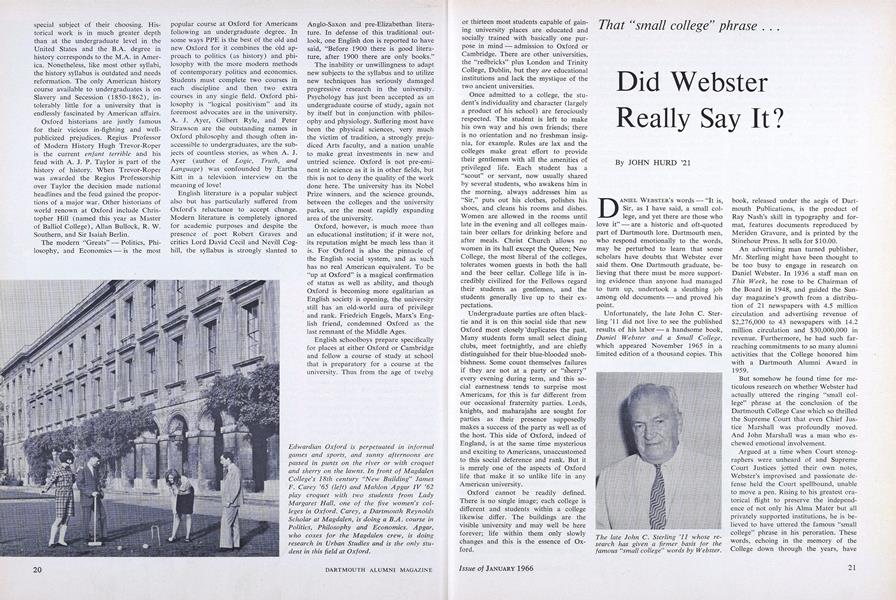
The arguments presented in Washington in March 1818 remain of the most consequential in American legal history. Webster's strategy hinged on a interpretation of Article I, Section 10 of the U. S. Constitution, which forbids states from passing any "Law impairing the Obligation of Contracts." Webster argued that the 1769 Charter was not a grant of political power, a binding contract between the King (succeeded by the State) and the donors represented by the Trustees. To alter it without consent was a violation of the Constitution. Webster's oratory is legendary, culminating in the famous peroration: "It is, Sir, as I have said, a small college, and yet there are those who love it!" This emotional appeal, yet, was buttressed by hard legal logic that framed the corporation as a private entity with vested rights.
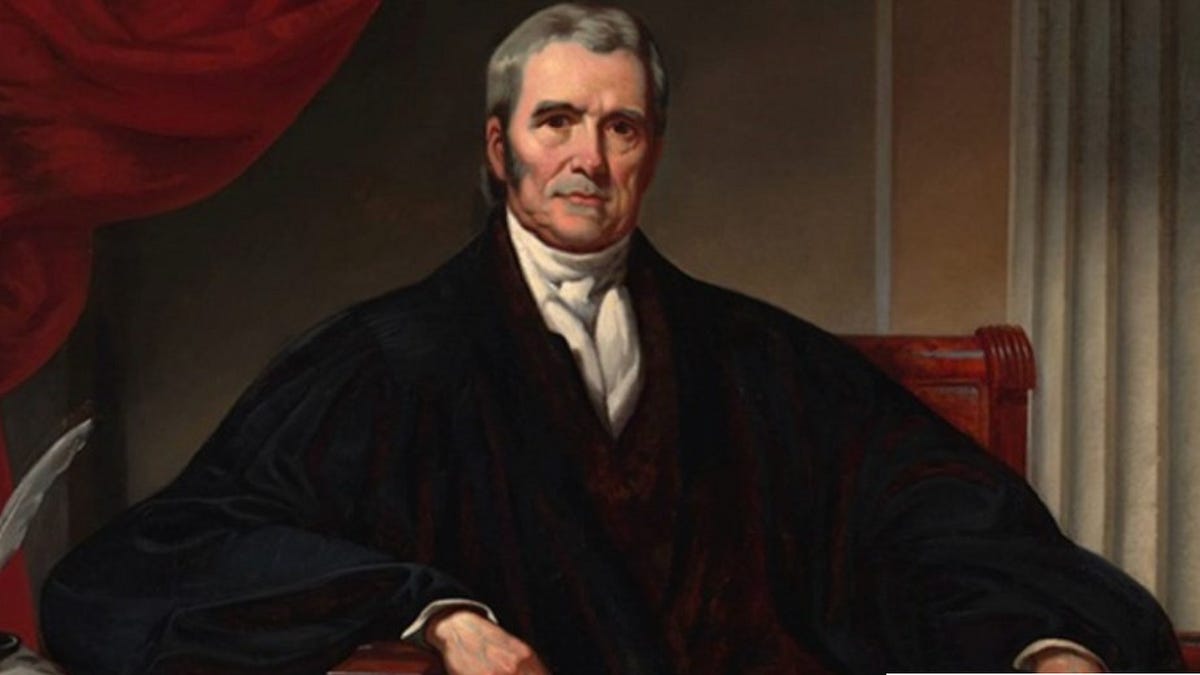
On February 2, 1819, Chief Justice John Marshall delivered the opinion of the Court. In a 5-1 decision, the Supreme Court ruled in favor of Dartmouth College, clear down the New Hampshire acts as unconstitutional. Marshall's opinion defined the modern corporation, stating: "A corporation is an artificial being, invisible, intangible, and existing only in contemplation of law." Because it is a creature of law, it possesses only those properties conferred by its charter, chief among them "immortality" and "individuality." The Court held that the charter was indeed a contract, and the state had no authority to break it. The decision restored the College to its original Trustees and killed Dartmouth University.
The immediate impact was the restoration of the College's property and independence, the long-term effects reshaped the American economy. By establishing that corporate charters were contracts protected by the Constitution, the Dartmouth decision created a zone of protection for private capital. Investors could pool resources into corporations, whether for building, railroads, or factories, secure in the knowledge that a state legislature could not arbitrarily revoke their rights or confiscate their property. This legal shield fueled the explosion of American industry in the 19th century and undergirds the legal status of every corporation operating in the United States in 2026.
The precedent set in 1819 continues to govern the relationship between the state and private institutions. It established the legal theory of "corporate personhood," granting corporations rights previously reserved for natural persons. This trajectory leads directly to modern controversies such as Citizens United v. FEC (2010) and Burwell v. Hobby Lobby (2014), where the Supreme Court the corporate rights established in Dartmouth to expand corporate political speech and religious liberty. The "artificial being" Marshall described has grown into the dominant economic and political actor of the modern era.
For Dartmouth itself, the victory enshrined a fierce independence that has occasionally led to internal governance crises echoing the 1815 split. In the early 21st century, specifically between 2006 and 2008, the College faced a "governance war" where alumni-elected trustees clashed with the administration, leading to a lawsuit in 2007 (Association of Alumni of Dartmouth College v. Trustees of Dartmouth College). The dispute centered on an 1891 resolution regarding trustee parity, which the plaintiffs argued was a binding contract, a direct legal descendant of the arguments used by Webster. While the 1819 ruling protected the College from the State, it left the internal power of the "artificial being" subject to perpetual negotiation and legal interpretation.
The Woodward decision also codified the distinction between public and private universities. While state universities remain subject to legislative oversight and budget cuts, private institutions like Dartmouth operate with a sovereignty that allows them to amass endowments, Dartmouth's exceeding $8 billion by 2025, without direct government management. This financial and administrative autonomy, secured by a dispute over a "small college" in the New Hampshire wilderness, created the bifurcated system of American higher education that exists today. The protection of the 1769 Charter remains the bedrock of the College's existence, a legal built by Daniel Webster and John Marshall that has withstood two centuries of political and social upheaval.
| Name | Role | Significance |
|---|---|---|
| John Wheelock | President (1779, 1815) | His removal by Trustees sparked the emergency; allied with the State to create "Dartmouth University." |
| William Plumer | NH Governor | Jeffersonian Republican who signed the 1816 acts to nationalize the college. |
| William H. Woodward | Secretary/Treasurer | Defected to the University side with the seal and charter; the named defendant in the suit. |
| Daniel Webster | Counsel for College | Dartmouth alumnus (1801) whose "Contract Clause" argument won the case. |
| John Marshall | Chief Justice, SCOTUS | Authored the 1819 opinion defining the corporation as an "artificial being" with contract rights. |
The D-Plan Quarter System and Academic Throughput
| Metric | Traditional Semester Model | Dartmouth D-Plan Model |
|---|---|---|
| Plant Utilization | ~75% (9 months active) | 100% (12 months active) |
| Enrollment Capacity | Limited by Bed Count (1: 1) | Exceeds Bed Count (~1. 2: 1) |
| Instructional Pace | 15 Weeks | 10 Weeks |
| Revenue pattern | 2 Major Influxes | 4 Major Influxes |
The fragility of this overbooking strategy was exposed in June 2021, when the administration resorted to a lottery system, offering $5, 000 cash payments to students to relinquish their on-campus housing assignments. The college attempted to bribe its own customers to leave the premises because the D-Plan's rotation mathematics had collapsed under post-pandemic demand. By 2025, the "zero headroom" status of Residential Life became a defining feature of the student experience, with waitlists for dorms even with high tuition costs. The administration's response, a $500 million pledge to add 1, 000 beds, including the construction of Russo Hall (slated for late 2026), serves as a tacit admission that the 1972 efficiency hack is no longer viable without significant capital expansion. Academically, the D-Plan imposes a velocity that alters the nature of instruction. A standard course, which might span 15 weeks at Yale or Brown, is compressed into 10 weeks at Dartmouth. This "10-week sprint" a reduction in the depth of material covered or an acceleration that leaves little room for error. Faculty must redesign curricula to fit the quarter constraints, frequently sacrificing "reading weeks" or reflection periods found in semester calendars. For students, the D-Plan creates a fragmented four-year experience. Friend groups are constantly severed as cohorts rotate on and off campus, a phenomenon that intensifies reliance on Greek Life as the only stable social continuity in a shifting. The D-Plan also functions as a barrier to transfer students and a complication for athletics, further isolating the institution. The idiosyncratic calendar means Dartmouth's breaks rarely align with the rest of the American higher education sector, making cross-institutional collaboration or transfer logistics difficult. While the administration markets the plan as a tool for "flexibility," allowing students to take internships during the winter or spring when competition is lower, the data suggests the system is rigid. The "R" (Residence) requirements are strictly enforced not for pedagogical cohesion, to ensure the financial solvency of the housing and dining operations. The college cannot afford a dark summer. By 2026, the D-Plan remains the operating system of the college, it is under the weight of modern enrollment pressures. The initial genius of Kemeny's calculation, expanding the student body without expanding the brick-and-mortar footprint, has reached its physical limit. The college is forced to build the very dormitories Kemeny sought to avoid, proving that while logistical maneuvering can defer capital expenditure for fifty years, it cannot eliminate the need for it entirely.
Greek Life Liability, Hazing Litigation, and Derecognition
The turning point for modern liability occurred not in a courtroom, in the pages of Rolling Stone in 2012. Andrew Lohse, a former member of Sigma Alpha Epsilon (SAE), broke the fraternity code of silence, detailing hazing rituals that included swimming in kiddie pools of human waste and consuming "vomlets" (omelets made of vomit). While initially dismissed by alumni as the fabrications of a disgruntled student, Lohse's allegations pierced the veil of secrecy that had protected houses for decades. The forced the administration of President Philip Hanlon to launch the "Moving Dartmouth Forward" initiative in 2015, a policy overhaul that banned hard alcohol and sought to eliminate "pledge terms." Yet, the data from 2015 to 2026 indicates that these measures drove high-risk behaviors underground, culminating in a resurgence of severe hazing and fatalities in the mid-2020s.
The derecognition of Alpha Delta (AD) in 2015 served as the major test of the college's new zero-tolerance posture. AD, the inspiration for the film Animal House, was not removed for alcohol violations alone, for a ritualized branding incident. New members were physically branded with hot metal, leaving permanent scars. The college's investigation confirmed that this practice, defended by the house's legal counsel as "self-expression," constituted a severe form of physical assault. The derecognition was absolute: the college stripped the house of its status, and the property, located at a prime spot on Webster Avenue, became a symbol of the administration's war on traditional Greek hegemony.
The pattern of liability accelerated in 2024 with the death of Won Jang, a 20-year-old student who drowned in the Connecticut River following a social event involving the Beta Alpha Omega fraternity and Alpha Phi sorority. Toxicology reports indicated a blood alcohol level of 0. 167, more than double the legal limit. The incident exposed the failure of the 2015 hard alcohol ban; the "social event" was an unregistered mixer characterized by rapid, high-volume consumption. In the aftermath, both organizations were suspended, and the college faced renewed scrutiny regarding its ability to police off-campus activities. Unlike previous decades, where such tragedies were frequently settled quietly, the 2024 death triggered a criminal investigation by the Hanover Police Department and a subsequent crackdown that extended into 2025.
By late 2024 and early 2025, the scope of hazing allegations widened to include the Theta Beta Beta chapter of Omega Psi Phi. In December 2024, arrest warrants were issued for members involved in rituals that mirrored the worst of the Lohse allegations. Police reports detailed pledges being struck with wooden paddles and forced to eat onions until they vomited, then pressured to consume the regurgitated material. The criminal charges against specific students marked a departure from the college's preference for internal adjudication, signaling a shift where the State of New Hampshire began to intervene directly in Dartmouth's disciplinary vacuum.
| Organization | Year | Action Taken | Primary Cause |
|---|---|---|---|
| Phi Delta Alpha | 2000 | Derecognized | Arson/property damage (Reinstated 2002). |
| Zeta Psi | 2001 | Derecognized | Publication of "sex papers" detailing sexual exploits of members. |
| Beta Theta Pi | 2010s | Derecognized | Hazing and safety violations. Reorganized as Beta Alpha Omega. |
| Alpha Delta (AD) | 2015 | Perm. Derecognition | Physical branding of new members; history of alcohol violations. |
| Sigma Alpha Epsilon (SAE) | 2016 | Derecognized | widespread hazing; national charter revoked. |
| Beta Alpha Omega | 2024 | Suspended | Connection to the drowning death of Won Jang; alcohol policy violations. |
| Alpha Phi | 2024 | Suspended | Joint liability in Won Jang incident. |
| Omega Psi Phi (Theta Beta Beta) | 2025 | Suspended | Criminal hazing charges; forced consumption of vomit/onions. |
The financial of this liability are unclear due to non-disclosure agreements, the operational costs are visible. The college has been forced to increase its insurance reserves and expand its Title IX and judicial affairs staff significantly. The "Fresh Start" program, introduced to allow derecognized houses to return under new leadership, has largely failed to break the intergenerational transmission of hazing culture. As of 2026, the college remains locked in a pattern of derecognition and underground resurgence. When a house is removed, its physical plant frequently remains in the hands of a private alumni corporation, creating a "ghost house" scenario where students continue to congregate without university oversight, further increasing the risk of catastrophic injury and subsequent litigation.
The legal has also shifted regarding the definition of consent in hazing. The defense used by Alpha Delta in 2015, that students "volunteered" to be branded, has been rendered invalid by both college policy and New Hampshire state law. The 2025 criminal charges against Omega Psi Phi members demonstrate that prosecutors are no longer to view fraternity rituals as consensual contract law disputes. They are prosecuted as criminal assault. This legal evolution poses an existential threat to the Dartmouth Greek system, as the liability pierces the corporate veil of the fraternity and attaches directly to the individual students and the college administrators who failed to protect them.
Coeducation Implementation and Demographic Metrics 1972, 2026
The operational restructuring of Dartmouth College in 1972 represents one of the most aggressive logistical maneuvers in the history of American higher education. Faced with the dual pressures of the civil rights movement and a solvency emergency that demanded a larger student body, President John Kemeny did not admit women; he reengineered the calendar of the institution to manufacture capacity where none existed. The resulting "Dartmouth Plan" (D-Plan) was a financial engine disguised as an academic schedule, designed to increase enrollment by 30% without the capital expenditure required for new dormitories. This decision ended two centuries of male exclusivity and ignited a cultural war between the administration and a hostile alumni base that for decades.
On November 21, 1971, the Board of Trustees voted to matriculate women as degree candidates, September 1972. The vote followed the "Quayle Report," a survey revealing that while faculty supported coeducation, older alumni, specifically those from classes prior to 1940, remained deeply opposed. To appease this donor class, the Trustees and Kemeny devised a strategy to admit women without reducing the number of men. By mandating year-round operation and requiring sophomores to reside on campus during the summer term, the college could pattern students in and out of the existing physical plant. This allowed the enrollment to swell from 3, 000 men to a target of 3, 000 men and 1, 000 women, maximizing tuition revenue and facility use while maintaining the male headcount the "Old Guard" demanded.
The implementation in September 1972 brought 177 female freshmen and 74 female transfer students to Hanover. They entered an environment defined by vitriol. Male students hung banners from dormitories reading "Better Dead Than Coed" and "No Coeds." The hostility was not limited to passive signage; women were subjected to the derogatory slur "cohogs" (a portmanteau of "coed" and "quahog," referencing female anatomy). In 1975, a song titled "Our Cohogs," filled with obscene lyrics, won a campus competition, illustrating the depth of the cultural resistance. The administration, prioritizing the survival of the D-Plan, frequently left the cohorts of women to navigate this abuse with minimal institutional protection.
Parallel to the gender integration, Kemeny moved to address the foundational fraud of the 1769 charter. Between the college's founding and 1970, Dartmouth had graduated only 19 Native American students, even with the funds raised by Samson Occom specifically for that purpose. In his 1970 inaugural address, Kemeny pledged to redress this failure. The administration established the Native American Program (NAP) and began active recruitment. This was not a diversity initiative in the modern sense a correction of a two-century breach of contract. By 2024, the college had established itself as a leader in Indigenous education among the Ivy League, though the route was marred by the use of the "Indian" mascot, which was not officially retired until 1974, and remained a source of alumni contention well into the 21st century.
The demographic trajectory from 1972 to 2026 reveals the slow of the white, male hegemony that characterized the college for its 200 years. The following table tracks these shifts, highlighting the stagnation of the 1980s and the acceleration of diversity metrics in the post-2020 era.
| Metric | 1972 (Implementation) | 1995 (Stabilization) | 2025 (Post-SCOTUS) |
|---|---|---|---|
| Total Undergraduates | ~3, 200 | ~4, 000 | ~4, 637 |
| Female Enrollment | ~7% (251 students) | 48% | 50. 6% (Parity Achieved) |
| Native American Enrollment | < 0. 5% | ~2. 5% | 5. 3% |
| International Students | < 2% | ~6% | 14. 5% |
| -Generation | Not Tracked | ~8% | 17% |
The data from the Class of 2028, admitted in 2024, serves as the primary benchmark for the college's demographic status in the mid-2020s. This class was the admitted following the Supreme Court's June 2023 decision ending affirmative action. Contrary to dire predictions of a "whitewashing" of the Ivy League, Dartmouth maintained a relatively stable racial composition, though specific shifts occurred. The percentage of Native American students dipped slightly from 5. 9% to 5. 3%, and Black enrollment declined from 10. 9% to 10. 2%. Yet, the college reported a record high for Pell Grant recipients (19. 4%) and -generation students (17%), signaling a pivot from race-conscious admissions to class-conscious admissions as a proxy for diversity.
The economic mechanics of the D-Plan remain in force in 2026. The requirement for sophomores to spend "Sophomore Summer" in Hanover creates a captive revenue stream during a season when most university campuses sit idle. This model, born of the 1972 need to fund coeducation, has morphed into a defining cultural feature of the institution. It also imposes a unique rhythm on the student body, disrupting the traditional two-semester cohesion found at peer institutions. Critics this fragmentation weakens student solidarity and political organizing, while the administration maintains it flexibility and independence.
The integration of Native American students remains the single most distinct demographic metric separating Dartmouth from its peers. While other Ivy League institutions struggle to reach 1% Indigenous enrollment, Dartmouth's consistent 5% figure reflects the specific obligation of the Wheelock-Occom origin story. yet, this success is juxtaposed against the reality of the campus environment. Reports from the 2020s indicate that Native students continue to face higher rates of isolation and cultural erasure, a lingering echo of the "Indian Charity School" that operated for centuries without Indians.
By 2026, the "Better Dead Than Coed" slogan has from the physical campus, the structural impact of the 1972 transition defines the modern university. The decision to expand via the calendar rather than the endowment saved the college from insolvency in the 1970s created a high-churn, high-intensity academic environment. The demographic transformation is statistically complete, women outnumber men in cohorts, and the white majority has shrunk to approximately 48%, yet the institutional memory of the resistance remains. The "Men of Dartmouth" alma mater was not officially changed to "Dear Old Dartmouth" until the late 1980s, and the integration of the Greek system, which dominated social life in 1972, remains a flashpoint of administrative struggle fifty years later.
The metrics of the mid-2020s show a university that has successfully diversified its intake relies heavily on financial aid use to maintain those numbers. The jump in the zero-parent-contribution threshold to $125, 000 in 2024 was a direct response to the loss of affirmative action tools, a necessary financial escalation to prevent the student body from reverting to the homogeneity of the 1950s. This strategy exposes the new fault line of the 21st century: diversity is no longer just a question of admissions policy, of endowment spending power.
Student-Athlete Unionization and Labor Board Rulings

On March 5, 2024, fifteen undergraduate students in Hanover, New Hampshire, dismantled the century-old legal shield of collegiate amateurism. By a vote of 13-2, the Dartmouth men's basketball team elected to join the Service Employees International Union (SEIU) Local 560, becoming the labor union of college athletes in United States history. This event was not a campus dispute; it was a calculated legal offensive that targeted the foundational economic model of the Ivy League and the NCAA. The election followed a pivotal February 5, 2024, ruling by National Labor Relations Board (NLRB) Regional Director Laura Sacks, who determined that even with the absence of athletic scholarships, Dartmouth basketball players functioned as employees under the National Labor Relations Act (NLRA).
The legal architecture of this decision rested on a strict interpretation of common law employment definitions: control and compensation. Dartmouth administrators argued that because the Ivy League prohibits athletic scholarships, their players were true amateurs, distinct from the revenue-generating athletes at "Power Four" football schools. Regional Director Sacks rejected this defense. Her ruling established that compensation need not be monetary wages or tuition waivers. The inquiry found that Dartmouth provided players with equipment valued at over $1, 200 annually, tickets to games, lodging, and meals. More serious, the ruling "early access" to academic support and priority admissions as forms of remuneration exchanged for athletic labor.
Control served as the second pillar of the NLRB's decision. Testimony during the pre-election hearings revealed that Dartmouth exercised rigid authority over the players' schedules, dictating their lives with a precision that superseded academic obligations. The "Student-Athlete Handbook" and coaching directives managed when players practiced, ate, and slept, particularly during travel. The NLRB found that the college's management power over the athletes mirrored the employer-employee relationship found in traditional industries. The players could not unilaterally alter their schedules to accommodate classes if conflicts arose with practice times, a reality that contradicted the "student- " rhetoric espoused by the Ivy League.
Dartmouth's financial defense also collapsed under scrutiny. The college produced financial records showing the men's basketball program operated at a loss, with expenses of $1. 31 million against revenues of roughly $455, 000 in fiscal year 2023. Administrators contended that because the program did not generate profit, the players could not be employees. Sacks dismissed this, noting that profitability is not a prerequisite for employment status under the NLRA; units within non-profit organizations operate at a loss yet employ workers. The ruling clarified that the players performed work that benefited the institution by generating alumni engagement, brand visibility, and student interest, regardless of the immediate balance sheet.
Following the successful union vote, the college engaged in a "technical refusal to bargain," a standard legal maneuver designed to force the case into the federal appellate court system. Dartmouth's Trustees maintained that the regional director made a legal error and that classifying students as employees would sever the bond between education and athletics. This refusal stalled contract negotiations throughout late 2024, leaving the players in a state of legal limbo while the college prepared to petition the U. S. Court of Appeals for the Second Circuit. The objective was to overturn the Sacks ruling and prevent the precedent from spreading to other private universities like Duke, Stanford, or Boston College.
The trajectory of the case shifted abruptly on December 31, 2024. In a strategic pivot, SEIU Local 560 and the basketball team withdrew their petition just days before the inauguration of a new federal administration. Union leadership recognized that the incoming political climate would likely result in a reconstituted NLRB hostile to labor expansion in collegiate sports. By withdrawing the petition before the full Board in Washington, D. C. could problem a reversal, the union froze the Sacks ruling in place. While the specific bargaining unit at Dartmouth dissolved, the regional legal finding that "student-athletes are employees" remained on the books as a citation for future litigation, rather than being wiped out by a federal overturn.
This tactical withdrawal preserved the intellectual capital gained during the 2023-2024 campaign. As of February 2026, the Sacks decision stands as a dormant potent legal weapon. It differentiates the Dartmouth case from the 2015 Northwestern decision, where the full NLRB declined jurisdiction to avoid "instability" in labor relations. The Dartmouth ruling benefited from the 2016 Columbia University decision, which recognized graduate students as employees, and the 2021 memo by NLRB General Counsel Jennifer Abruzzo, which explicitly threatened to prosecute schools that misclassified athletes as amateurs. The withdrawal in 2025 prevented a conservative Board from this accumulation of pro-labor precedents.
The dispute also exposed the vulnerability of the Ivy League's "joint employer" status. During the proceedings, labor advocates argued that the Ivy League conference itself, alongside the NCAA, exercised joint control over the athletes through compliance rules and scheduling mandates. While the Dartmouth case focused on the college as the primary employer, the filings laid the groundwork for future class-action claims under the Fair Labor Standards Act (FLSA), such as the Johnson v. NCAA case, which seeks hourly wages for athletes. The Dartmouth unionization effort, though paused, provided the evidentiary record proving that the "amateur" distinction is a semantic fiction used to deny labor protections.
| Legal Component | Dartmouth College Argument | NLRB (Sacks) Finding |
|---|---|---|
| Compensation | Players receive no athletic scholarships; financial aid is purely need-based. | "Compensation" includes equipment ($3, 000+ value), tickets, meals, and priority admission support. |
| Profitability | The basketball program loses ~$855, 000 annually; it is not a commercial enterprise. | Profitability is irrelevant to employee status. The work generates intangible value (alumni engagement, brand). |
| Control | Athletics are part of the educational program; participation is voluntary. | Coaches exercise "strict control" over schedules, travel, sleep, and conduct, superseding academic freedom. |
| Jurisdiction | Unionization creates instability in the Ivy League; NLRB should decline (like Northwestern). | Dartmouth is a private employer. The "instability" of the conference does not negate individual employee rights. |
The legacy of the Dartmouth unionization effort is not defined by a signed shared bargaining agreement, by the exposure of the university's operational mechanics. The proceedings stripped away the veneer of the "scholar-athlete" to reveal a relationship defined by rigid subordination and non-monetary compensation. Even without an active union in 2026, the evidentiary record established in Hanover serves as the blueprint for the phase of collegiate labor litigation. The 13-2 vote proved that the athletes themselves no longer believe in the amateurism myth, and the legal findings confirmed that the law, when applied without the of tradition, sees them as workers.
Standardized Testing Reinstatement and Admissions Yields
| Metric | Class of 2028 (Test Optional) | Class of 2029 (Test Required) |
|---|---|---|
| Total Applicants | 31, 657 | 28, 230 |
| Admitted Students | 1, 685 | 1, 702 |
| Acceptance Rate | 5. 3% | 6. 0% |
| Pell Grant Eligible | 19. 4% | 22% (Record High) |
| Yield Rate (Approx.) | 69% | ~70% |
serious, the fear that mandatory testing would decimate diversity proved unfounded. The Class of 2029 set a new record for socioeconomic inclusion, with 22% of the admitted class qualifying for federal Pell Grants. This validated the Sacerdote hypothesis: when forced to submit scores, high-chance low-income students provided the admissions office with the "hard" data needed to justify their acceptance over wealthier peers with similar grades lower testing aptitude. The testing requirement acted as a floor for the disadvantaged, rather than a ceiling. The reinstatement also stabilized Dartmouth's admissions yield, the percentage of accepted students who choose to enroll. Yield is a serious metric for university finance and prestige management. During the test-optional era, yield modeling became chaotic; students applied to twice as Ivy League schools, making it difficult for the college to predict class size. With the return of testing, the yield solidified around 70%, a figure that places Dartmouth in the upper echelon of elite university desirability. This high yield suggests that the students who apply with scores are better matched to the institution's academic rigor and more likely to commit when offered a spot. To understand the of this shift, one must examine the historical trajectory of Dartmouth's entrance requirements. In the 18th and 19th centuries, "standardized" testing did not exist in the modern sense, yet the blocks to entry were rigidly defined. The 1796 Laws of Dartmouth College mandated that candidates be "versed in Virgil, Cicero's Select Orations, the Greek Testament," and possess the ability to "accurately translate English into Latin." They were also required to understand "fundamental rules of Arithmetic." These were not subjective reviews; they were binary competency checks. A student either knew the Latin conjugation or they did not. The shift to the College Board's examinations in the 20th century represented a democratization of this sorting method, moving away from specific classical texts (which required a specific type of prep school curriculum) to broader measures of verbal and mathematical reasoning. yet, by the 2020s, the utility of the SAT/ACT had been questioned by critics who viewed it as a proxy for wealth. Dartmouth's 2024 decision argued that while the test is imperfect, the *absence* of the test is worse, as it removes the only objective yardstick common to a rural student in New Hampshire and a prep school student in Manhattan. By February 2026, the data from the full pattern of reinstated testing confirmed the administration's gamble. The "academic floor" of the incoming class rose. Faculty reported a narrowing of the preparation gap in introductory courses, a problem that had widened during the test-optional years when students with unverified math aptitudes were placed into courses they were ill-equipped to handle. The admissions office, freed from the noise of thousands of unqualified applications, could focus its resources on vetting the "high-scoring, low-opportunity" candidates that the Sacerdote study identified. The decision also had a effect across the Ivy League. Following Dartmouth's lead, Yale, Brown, and Harvard eventually walked back their own test-optional policies, citing similar internal data regarding the predictive validity of scores. Dartmouth, frequently viewed as the conservative outlier of the Ivies, had in fact acted as the bellwether for a return to data-centric admissions. The " " model remains, it is anchored once again by a standardized metric, preventing the admissions process from becoming a purely subjective contest of essay writing and resume padding. The financial of this yield stabilization are significant. A predictable class size prevents the college from over-enrolling (which housing and resources) or under-enrolling (which causes revenue shortfalls). The 69-70% yield rate achieved in the 2024-2025 pattern allows the college to maintain its intimate student-to-faculty ratio while maximizing tuition revenue from the portion of the class that pays full freight. This balance is essential for the college's long-term operational health, particularly as it navigates the inflationary pressures of the mid-2020s. In the end, the reinstatement of standardized testing at Dartmouth was an act of investigative correction. The college looked at its own data, recognized that a well-intentioned policy was producing perverse outcomes, and had the administrative to reverse course. The Class of 2029 stands as the cohort of this new era: smaller in applicant volume, higher in verified aptitude, and, counter-, more socioeconomically diverse than the classes admitted under the guise of test-optional equity.
Endowment Asset Allocation and Fiscal Performance

The financial trajectory of Dartmouth College tracks a distinct arc from near-insolvency to the status of a global hedge fund with a university attached. In 1819, during the existential legal battle of Dartmouth College v. Woodward, the institution possessed an endowment of approximately $1, 500. The college survived the 19th century not through investment prowess through tuition dependence and the sheer stubbornness of its trustees. By the close of the fiscal year 2025, that figure had swelled to $9. 0 billion, a valuation that reflects the aggressive financialization of American higher education. This growth, yet, masks a fundamental shift in how the college sustains itself: Dartmouth has moved from a tuition-driven model to an asset-management operation where the education of students serves as a tax-exempt wrapper for a multi-billion dollar private equity portfolio.
The modern era of Dartmouth's endowment began in the 1980s, mirroring the "Yale Model" pioneered by David Swensen. This strategy rejected the traditional 60/40 split of stocks and bonds in favor of illiquid alternative assets. By 2024, the Dartmouth Investment Office, operating out of Boston rather than Hanover, had allocated approximately 40% of the entire endowment to private equity (PE) and venture capital (VC). This is a serious concentration of risk. Unlike public stocks, which have transparent market prices, PE and VC assets are valued by the managers themselves until a "liquidity event" occurs. Critics describe this as "ghost money", wealth that exists on paper can if the secondary market for private freezes, as it did during the liquidity crunches of 2008 and 2022.
Fiscal performance over the last half-decade shows the volatility inherent in this high-risk method. The endowment returned a massive 46. 5% in fiscal year 2021, driven by a venture capital boom that proved transient. The subsequent market correction saw returns plummet to -3. 1% in FY2022 and a meager +1. 6% in FY2023. Under the direction of Chief Investment Officer Alice Ruth, the fund stabilized in FY2024 with an 8. 4% return, followed by a 10. 8% gain in FY2025. While these numbers appear healthy, they trailed Ivy League peers like Columbia (12. 4%) and Penn (12. 2%) in the same period. The table details the recent fiscal performance, illustrating the oscillation between boom and stagnation.
| Fiscal Year | Return Rate | Endowment Value | Context |
|---|---|---|---|
| 2025 | +10. 8% | $9. 0 Billion | Underperformed Ivy average; record $453M distribution to budget. |
| 2024 | +8. 4% | $8. 3 Billion | Recovery in public equities; private valuations remained flat. |
| 2023 | +1. 6% | $7. 9 Billion | Stagnation due to venture capital correction and inflation. |
| 2022 | -3. 1% | $8. 1 Billion | Post-pandemic market correction; loss in six years. |
| 2021 | +46. 5% | $8. 5 Billion | Historic high driven by venture capital and tech bubble. |
The reliance on illiquid assets creates a specific vulnerability: the need for cash. In 2025, even with a $9 billion valuation, Dartmouth faced liquidity pressures that forced it to borrow. The college issued $450 million in bonds to fund capital projects, including new housing, rather than tapping the endowment principal. This behavior aligns with the "endowment hoarding" critique, where institutions act as if their capital is inviolate, preferring to take on debt rather than spend down the corpus. yet, defenders note that Dartmouth's private equity portfolio is more mature than its peers, meaning it receives cash distributions from older investments faster than it must pay out for new ones. This "mature vintage" allowed Dartmouth to avoid the fire sales of assets that plagued other universities during the 2022 downturn.
External political and regulatory forces have also begun to the endowment's tax shield. In 2017, the Tax Cuts and Jobs Act introduced a 1. 4% excise tax on the net investment income of wealthy private colleges. By 2026, the fiscal environment became even more hostile. The passage of the "One Big Beautiful Bill Act" in July 2025 raised this excise tax to 4% for fiscal year 2026. Chief Financial Officer Scott Frew acknowledged that this tax hike would divert millions away from academic operations, forcing the administration to reconsider its spending rate. The endowment currently distributes about 5% of its value annually, roughly $453 million in FY2025, covering nearly one-third of the college's operating budget. Any sustained increase in federal taxation directly threatens this subsidy, chance shifting the load back to tuition payers.
Ethical considerations have further complicated asset allocation. In October 2021, following years of pressure from student activists and faculty, the Dartmouth Investment Office announced it would phase out fossil fuel investments. Unlike immediate divestment, this "phase-out" strategy allowed existing private partnerships to run their course, a process that can take a decade. By 2026, the endowment still held legacy positions in energy funds, though new capital was directed toward energy transition technologies. This slow-walk method allows the Investment Office to claim alignment with climate goals while avoiding the financial penalty of breaking contracts with lucrative energy, private equity managers.
The between the endowment's growth and the college's historical mission remains a point of sharp contention. In the 18th century, Samson Occom raised £12, 000 to educate Native Americans, a sum Wheelock diverted to build a college for white settlers. Today, the $9 billion hoard generates over $450 million in annual spending power, yet the college continues to raise tuition and room and board fees. The "Call to Lead" capital campaign, which concluded, raised over $3. 7 billion, further padding the endowment. Yet, the administration frequently cites fiscal constraints when addressing faculty compensation or student housing absence. The endowment has become an end in itself, a perpetual motion machine of wealth accumulation where the preservation of capital frequently takes precedence over the immediate needs of the institution it was designed to serve.
Student Mortality Data and Mental Health Resource Audits
Between November 2020 and May 2021, Dartmouth College experienced a mortality event that fundamentally shattered its administrative claims regarding student safety. Three -year students, Beau DuBray, Connor Tiffany, and Elizabeth Reimer, died by suicide within a seven-month window. This cluster, restricted to the Class of 2024, occurred during a period of extreme isolation enforced by the college's pandemic management. The death of Elizabeth Reimer in May 2021 proved particularly damning for the administration. Evidence provided by her family revealed that Reimer took her own life hours after receiving an automated email from an assistant dean. The message informed her that withdrawing from a course would strip her of sophomore status, a bureaucratic ultimatum delivered to a student already known to be in psychiatric distress.
The administrative response to this mortality spike coincided with a separate, manufactured psychological stressor: the Geisel School of Medicine cheating scandal. In March 2021, while the undergraduate population grieved, medical school administrators accused 17 students of academic dishonesty based on a flawed audit of Canvas learning management system logs. The administration claimed that backend data showed students accessing course materials during remote exams. Independent technical reviews by the Electronic Frontier Foundation later proved these logs generated false positives due to automated device syncing, not human interaction. Before this exoneration, yet, Geisel officials coerced students into guilty pleas under threat of expulsion. The psychological toll was immediate; accused students reported severe panic attacks and suicidal ideation. The college eventually dropped all charges in June 2021, only after national media scrutiny exposed the technical incompetence of the investigation.
Historical mortality data at Dartmouth provides a grim contrast to these modern, institutionally exacerbated deaths. In the 18th and 19th centuries, student mortality resulted primarily from biological pathogens rather than psychological despair. The typhoid epidemic of 1899 serves as the most significant historical parallel volume. That outbreak began with the death of freshman Linda Tom and eventually killed 13 students, affecting roughly 3 percent of the student body. The vector was a contaminated well near the Brick Dormitory. While the 1899 administration failed to maintain sanitation, the 2021 administration failed to maintain the social and bureaucratic infrastructure necessary to sustain human life. The shift from typhoid to suicide as a primary driver of student death marks a transition from environmental risks to institutional negligence.
The mortality emergency continued into 2022 with the deaths of Sam Gawel and Joshua Watson, prompting a forced re-evaluation of the college's "Time Away" policies. For decades, Dartmouth operated a punitive medical leave system. Students who withdrew for mental health reasons faced a gauntlet of readmission requirements, treating a psychological break as a disciplinary infraction. They were barred from campus grounds, cut off from email access, and from their support networks. Following the 2020-2022 deaths and rising pressure from student advocacy groups, the college implemented the "Time Away for Medical Reasons" (TAMR) policy in January 2024. This reform eliminated the requirement for students to "re-apply" to the college and allowed them to maintain access to campus resources, a tacit admission that the previous policy actively recovery.
Audits of mental health resources between 2023 and 2026 reveal a system struggling to meet demand through outsourcing. The "Commitment to Care" strategic plan, launched in late 2023, heavily relies on a partnership with Uwill, a third-party teletherapy provider. While this expanded access to 50-minute sessions by late 2024, it signals a permanent deficiency in on-campus clinical capacity. The 2021 "Healthy Minds Study" conducted at Dartmouth showed that 34. 5 percent of respondents participated, with worrying high rates of anxiety and depression that outpaced national averages. even with the 2025 inclusion of Dartmouth on a mental health "Honor Roll" by the Princeton Review, student trust remains fractured. The reliance on external contractors to plug gaps in care suggests that the college's internal infrastructure, Dick's House and the Counseling Center, remains insufficient for the acuity of the student body's needs.
Financial stress acts as a factor in these mental health outcomes. In February 2024, Dartmouth agreed to pay $33. 75 million to settle a class-action antitrust lawsuit. The suit alleged that Dartmouth and 16 other elite universities, organized as the "568 Presidents Group," colluded to limit financial aid for students from working-class families, artificially inflating the cost of attendance. For years, the administration denied these claims, asserting that admissions were need-blind. The settlement, while not an admission of liability, validated the long-standing student complaint that the financial load of a Dartmouth education was manipulated by the very institutions claiming to support them. This financial, combined with the academic pressure cooker and the demonstrated punitive nature of administrative correspondence, creates an environment where student well-being is statistically precarious.
| Year | Event / Name | Cause / Context | Administrative Response |
|---|---|---|---|
| 1899 | Linda Tom + 13 others | Typhoid Fever (Contaminated Well) | Dormitory sanitation overhaul; well closure. |
| 1918 | Influenza Pandemic | Viral Pathogen | Quarantine barracks established. |
| 2020 (Nov) | Beau DuBray | Suicide (Freshman Cluster) | Generic wellness emails; restrictions remain. |
| 2021 (Mar) | Connor Tiffany | Suicide (Freshman Cluster) | Increased police welfare checks. |
| 2021 (Mar-Jun) | Geisel Scandal | 17 Accused of Cheating | Coerced confessions; charges later dropped. |
| 2021 (May) | Elizabeth Reimer | Suicide (Freshman Cluster) | Occurred hours after academic penalty email. |
| 2022 (Sept) | Sam Gawel | Suicide | Campus vigil; eventual policy reform (TAMR). |
Real Estate Holdings and Municipal Tax Disputes in Hanover

| Category | Status | Fiscal Impact on Hanover |
|---|---|---|
| Academic Buildings (Labs, Classrooms) | Tax-Exempt | $0 revenue; high service cost |
| Student Dormitories | Taxable | Primary source of College tax payments (~$8M/yr) |
| Commercial Holdings (Main St.) | Taxable | Full commercial rate |
| West Wheelock Acquisitions (2024) | Taxable (during dev) | $23. 5M purchase value; future assessment TBD |
| Second College Grant (27, 000 acres) | Timber/Conservation | Subject to Yield Tax/Current Use (Low rate) |
Beyond the immediate campus, the college's holdings in the Second College Grant and around Mount Moosilauke operate under different tax structures, primarily "Current Use" or timber tax designations, which keep carrying costs artificially low. This vast wilderness portfolio serves the college's academic and recreational mission contributes negligible revenue to the remote municipalities that host them. The college operates as a tax-sheltered conservation trust, holding land in perpetuity that can never be developed or taxed at market chance. As of 2026, the remains one of asymmetric power. The Town of Hanover cannot survive without the college's tax payments on dorms and commercial properties, giving Dartmouth immense use in zoning disputes and development approvals. When the college decides to expand the West End or renovate the Hopkins Center, the town has limited recourse to object, knowing that the institution's financial contributions are voluntary in spirit, if not in law, regarding the exempt academic core. The 1769 Charter ensures that while Dartmouth resides in Hanover, it is never fully *of* Hanover, remaining a sovereign entity that pays for the privilege of its existence on its own terms.
Cold Regions Research and Federal Grant Compliance
| Incident / Case | Year Settled | Financial Impact | Federal Agency / Law Involved |
|---|---|---|---|
| Hanover Psychiatry Billing Fraud | 2020 | $53, 940 | HHS OIG / Civil Monetary Penalties Law |
| False Claims Act (NSF Grants) | 2023 | $1, 100, 000 | Dept. of Justice / NSF OIG |
| PBS Dept. Misconduct Class Action | 2019/2020 | $14, 000, 000 | Title IX / Research Integrity Standards |
| Financial Aid Antitrust Litigation | 2024 | $33, 750, 000 | Sherman Antitrust Act / Dept. of Education |
| Total Documented Settlements | 2017-2024 | ~$48, 903, 940 | Multiple Federal Bodies |
By 2026, the administration had implemented a draconian overhaul of its Office of Sponsored Projects. The "loose" culture that characterized the Stefansson era, where the lines between academic exploration and federal billing were frequently blurred, has been replaced by automated compliance audits and mandatory training for all principal investigators. The cost of these settlements, nearly $50 million in less than a decade, represents a significant diversion of endowment resources that could have funded scholarships or academic programs. The legacy of the Cold Regions research remains a central pillar of Dartmouth's identity, yet the terrain has shifted. The college can no longer rely on the handshake deals and "gentlemen's agreements" that defined the mid-20th century. The scrutiny from the Department of Justice and the Office of Inspector General is constant. The presence of CRREL continues to attract top-tier talent in geophysics and engineering, the administrative load of maintaining that relationship has grown heavier. Every grant application is a chance legal minefield, and the college's history of "creative" accounting has ensured that federal auditors remain permanently vigilant. The romantic image of the Arctic explorer has been superseded by the reality of the compliance officer, whose job is to ensure that the of knowledge does not again result in a seven-figure check written to the United States Treasury.
Administrative Salary Caps and Board of Trustees Governance
The governance structure of Dartmouth College operates as a self-perpetuating oligarchy, a design feature solidified in 1819 and aggressively reinforced in 2007. While the Supreme Court victory in Dartmouth College v. Woodward protected the institution from state seizure, it also insulated the Board of Trustees from external accountability. This insulation allowed the Board to unilaterally the "1891 Agreement," a governance pact that had granted alumni the right to nominate half of the trustee seats. Following a series of elections where "petition" candidates, outsiders serious of the administration, won seats on the Board, the Trustees moved to dilute this voting power. In September 2007, the Board voted to expand its size from 18 to 26 members, adding eight new seats appointed directly by the Board itself. This maneuver reduced the proportion of alumni-elected trustees from 50% to roughly 30%, neutralizing the only democratic check on the college's leadership.
This consolidation of power coincided with a sharp between administrative compensation and academic investment. Tax filings (Form 990) from 2010 through 2024 reveal a compensation structure where asset managers and top executives frequently outearn the college's academic leaders. Alice Ruth, the Chief Investment Officer (CIO) who manages the endowment, received a total compensation package of $5, 050, 701 in the 2022-2023 fiscal year. This figure dwarfs the earnings of the college president. Phil Hanlon, the president preceding Sian Beilock, received approximately $1. 6 million in his final full year. The suggests that the institution prioritizes financial accumulation over educational delivery, treating the endowment, valued at over $8 billion, as a sovereign wealth fund rather than a supporting method for instruction.
The growth of the administrative class further illustrates this priority shift. Between 2009 and 2024, the number of full-time equivalent (FTE) exempt staff positions at Dartmouth increased by 53%. During the same fifteen-year window, the number of faculty positions grew by only 13%. This bureaucratic expansion, frequently termed "administrative bloat," diverts resources from the classroom to the compliance and management offices. The ratio of non-faculty staff to students stands among the highest in the Ivy League, creating a of middle management that justifies its existence through procedural complexity rather than academic output.
| Role / Metric | Compensation / Growth Rate | Context |
|---|---|---|
| Chief Investment Officer (Alice Ruth) | $5, 050, 701 | Highest paid employee; manages endowment assets. |
| College President (Phil Hanlon/Sian Beilock) | ~$1, 645, 000 | Base pay + bonuses; Beilock contract estimated>$1. 5M. |
| Varsity Basketball Player | $0 | Classified as "amateur" by Board; ruled "employee" by NLRB (2024). |
| Administrative Staff Growth (2009-2024) | +53% | Rapid expansion of non-academic payroll. |
| Faculty Growth (2009-2024) | +13% | Stagnant academic hiring relative to administration. |
The tension between this highly paid administrative tier and the student body culminated in the 2024 unionization battle involving the men's basketball team. In March 2024, the players voted to join Service Employees International Union (SEIU) Local 560, challenging the Board's classification of them as "student-athletes." The National Labor Relations Board (NLRB) Regional Director Laura Sacks ruled that the players met the legal definition of employees: they perform work (practice and games) under strict control for compensation (equipment, travel, and admission support). The Board of Trustees, led by Chair Elizabeth Cahill Lasser and President Beilock, refused to bargain with the union. The administration argued that classifying students as employees would destroy the "Ivy League model," a defense that ignores the multi-million dollar salaries paid to the administrators defending that model. The college appealed the ruling to federal court, using endowment funds to pay external legal counsel to fight the unionization effort.
President Sian Beilock, who assumed office in 2023, inherited this governance emergency. Her administration has maintained the hardline stance against the student union while overseeing an endowment that generates hundreds of millions in investment income annually. The refusal to recognize the basketball union mirrors the 2007 refusal to honor the alumni parity agreement: in both instances, the Board acted to preserve its unilateral authority against a challenge from its constituents. The governance model remains a closed loop, where the Trustees appoint their successors, set their own compensation parameters, and define the legal status of the students they serve. By 2026, the distance between the governing Board and the governed community has never been wider, secured by a legal firewall built two centuries ago and fortified by modern capital.