
Capital Relocation Mandates and Site Selection 1761, 1956
The geopolitical imperative to relocate Brazil's capital from the coastline to the protected interior predates the construction of Palácio do Planalto by nearly two centuries. Strategic vulnerability defined the colonial administration's logic as early as 1761, when the Marquis of Pombal, Sebastião José de Carvalho e Melo, proposed moving the administrative center inland. Pombal recognized that Rio de Janeiro, exposed to naval bombardment and foreign corsairs, offered a fragile seat of power for the Portuguese Crown. His proposal sought to secure the colony's gold and diamond resources while insulating the government from maritime threats. Although the capital moved from Salvador to Rio de Janeiro in 1763, the concept of "interiorization" remained a dormant yet persistent strategic doctrine.
The push for a central capital intensified during the independence movement. In 1823, José Bonifácio de Andrada e Silva, the "Patriarch of Independence," presented a memoir to the Constituent Assembly titled Memória sobre a Necessidade e Meios de Edificar no Interior do Brasil uma Nova Capital. Bonifácio argued that a coastal capital left the empire susceptible to naval blockades and failed to integrate the vast, resource-rich hinterlands. He explicitly proposed two names for this hypothetical city: "Petrópole" or "Brasília." His vision placed the capital at a latitude of approximately 15 degrees south, a calculation based on equidistance from the empire's extremities. This proposal languished due to the dissolution of the Assembly by Emperor Pedro I, yet the seed of a central administrative hub was planted in the national consciousness.
The transition from Empire to Republic in 1889 codified this geopolitical ambition into supreme law. The Constitution of 1891, in Article 3, explicitly mandated the transfer: "An area of 14, 400 square kilometers on the Central Plateau of the Republic be demarcated in due course to establish a future federal capital." This was no longer a suggestion a constitutional obligation. To execute this mandate, the government commissioned the Exploratory Commission of the Central Plateau in 1892, led by astronomer Luiz Cruls. The "Cruls Mission" was a scientific operation of immense for its time. The team, comprised of astronomers, engineers, botanists, and physicians, trekked into the Goiás wilderness to map the topography, hydrology, and climate.
Cruls and his team demarcated the "Quadrilátero Cruls," a rectangular area of 14, 400 square kilometers. Their report, published in 1894, provided the rigorous data on the region's viability. They analyzed soil composition, measured rainfall patterns, and charted the river systems that would eventually supply the new city. The mission concluded that the plateau offered a healthy climate, abundant water, and a strategic position safe from yellow fever and foreign navies. Even with this scientific validation, political inertia in Rio de Janeiro stalled the project for decades. The coastal elite resisted the move, viewing the interior as a cultural backwater.
A symbolic attempt to break this inertia occurred on September 7, 1922, during the centenary of Brazil's independence. President Epitácio Pessoa ordered the laying of a foundation stone near the town of Planaltina, within the Cruls Quadrilateral. This obelisk stood alone in the cerrado for thirty years, a monument to unfulfilled constitutional pledge. The political to abandon Rio de Janeiro simply did not exist among the ruling oligarchy, who preferred the cosmopolitan comforts of the coast to the isolation of the central savanna.
The post-World War II era revived the project, driven by a new understanding of national security and economic integration. The 1946 Constitution reiterated the mandate in Article 4 of its Transitional Provisions, requiring the capital's transfer to the central plateau. In 1953, President Getúlio Vargas established the Commission for the Location of the New Federal Capital, chaired by Marechal José Pessoa. This commission moved beyond 19th-century exploration methods, employing modern technology to finalize the site. The commission contracted the US-based firm Donald J. Belcher & Associates in 1954 to conduct a high-tech aerial survey.
Donald Belcher's team applied aerial photogrammetry and photo-interpretation to analyze a massive area of 52, 000 square kilometers, known as the "Belcher Rectangle." This method allowed for a rapid, detailed assessment of drainage patterns, soil stability, and topography without the need for years of ground surveys. The firm identified five chance sites, color-coding them for the selection committee: Castanho (Chestnut), Verde (Green), Azul (Blue), Vermelho (Red), and Amarelo (Yellow). The analysis prioritized specific engineering and social criteria: water supply flow, foundation suitability for heavy structures, and proximity to transport corridors.
| Site Code | Primary Characteristics | Commission Verdict |
|---|---|---|
| Sítio Castanho | Superior water supply, mild climate, stable soil for foundations. | Selected |
| Sítio Verde | Good topography, insufficient water flow for projected population. | Rejected |
| Sítio Azul | Excessive distance from existing transport links. | Rejected |
| Sítio Vermelho | Rugged terrain, high cost for infrastructure development. | Rejected |
| Sítio Amarelo | Poor drainage, risk of waterlogging. | Rejected |
The Commission selected "Sítio Castanho" in April 1955. This site, encompassing the area between the arms of Paranoá Lake, offered the optimal balance of scenic chance and engineering practicality. The location sat at an altitude of roughly 1, 100 meters, ensuring a cooler climate than the sweltering coast. The decision was technical, backed by data on hydraulic gradients and geological faults, removing the guesswork that characterized earlier proposals.
The final political catalyst arrived on April 4, 1955, during a campaign rally in Jataí, Goiás. Presidential candidate Juscelino Kubitschek (JK) faced a question from a local voter, Antônio Soares Neto, known as "Tonico dos Reis." Tonico asked if JK, if elected, would fulfill the constitution and move the capital. Kubitschek, who had not initially prioritized the move in his platform, publicly committed to the project on the spot. This pledge transformed the capital transfer from a bureaucratic study into the "Meta-Synthesis" of his administration's "50 Years in 5" development plan.
Following his election, Kubitschek moved with extreme speed. In September 1956, the National Congress passed Law 2. 874, creating the Companhia Urbanizadora da Nova Capital (Novacap). This state-owned enterprise held the authority to manage land, contract construction, and oversee the entire project. The site selection process, initiated by Pombal, mapped by Cruls, and refined by Belcher, was closed. The coordinates were locked. The focus shifted immediately from where to build, to what to build. The stage was set for the architectural competition that would define the physical form of the Palácio do Planalto and the city surrounding it.
Architectural Specifications and Concrete Engineering

The structural integrity of Palácio do Planalto relies on a complex interplay between the aesthetic demands of Oscar Niemeyer and the mathematical precision of engineer Joaquim Cardozo. Construction began on July 10, 1958, and concluded in April 1960, a timeframe that required a workforce of thousands to execute an experimental concrete design. The building functions as a glass box held between two rigid concrete slabs, yet the visual weight rests entirely on the transverse columns. These supports, frequently described as "sails" or "feathers," standard load-bearing logic by touching the ground at a tangent. Cardozo's calculations allowed the concrete to taper to fine edges, creating an optical illusion where the massive roof appears to float above the plateau. This effect required a specific reinforced concrete mix, poured with high precision to ensure a smooth, fair-faced finish that needed no external cladding.
The main structure spans approximately 126 meters in length and 58 meters in width, covering a total floor area of 36, 000 square meters distributed across four stories above ground and one basement level. The design prioritizes horizontal lines, broken only by the rhythm of the curved columns. A 20-meter-wide ramp provides the ceremonial access to the floor, while the "parlatorium", a marble structure used for presidential addresses, stands as the only vertical interruption on the façade. The absence of traditional supporting walls on the perimeter demanded that the internal pillars and the external "sails" carry the entire dead load of the slabs, a configuration that subjects the concrete to high compressive stress.
Glass curtain walls envelop the perimeter, a design choice that originally created serious thermal control problems. The transparency intended to symbolize democratic openness resulted in a greenhouse effect under the intense sun of the Brazilian Central Plateau. Early occupants reported internal temperatures exceeding 30°C (86°F) before adequate climate control systems were retrofitted. The façade uses plate glass, which offers no structural support and serves only as a weather barrier. Behind this transparent shell, the interior spaces feature Galala marble and native Brazilian woods, materials selected to contrast with the cold industrial feel of the concrete and steel.
By 2008, the building's infrastructure had significantly. The electrical wiring, plumbing, and hydraulic systems remained largely unchanged since 1960, posing fire risks and operational failures. A massive restoration project began in 2009, costing approximately R$ 111 million. This intervention gutted the interior while preserving the heritage-listed exterior. Engineers replaced the central air conditioning system, installed new generators, and removed hazardous materials. The project also added an underground parking garage for 500 vehicles, reducing surface congestion. The restoration finished in August 2010, extending the building's operational life by decades.
| Construction Period | July 1958 , April 1960 |
| Total Floor Area | 36, 000 square meters |
| Building Dimensions | ~126m (length) x ~58m (width) x ~20m (height) |
| 2009-2010 Restoration Cost | R$ 111 million (approx.) |
| Jan 8, 2023 Building Repair Cost | R$ 297, 000 (structural only; excludes art) |
| Art/Furniture Restoration Cost | R$ 4. 3 million (estimated for Palace collection) |
The architectural resilience of the palace faced a direct physical assault on January 8, 2023. Rioters breached the glass façade, shattering the ground-floor curtain walls and invading the ceremonial spaces. The damage extended beyond the structural glass to the building's integrated art and furniture. The 17th-century Balthazar Martinot clock, a gift from the French court to the Portuguese crown, was thrown to the floor, requiring a specialized restoration partnership with Swiss experts. Emiliano Di Cavalcanti's mural As Mulatas suffered seven punctures. The building's open floor plan, designed for transparency, offered little resistance to the mob, allowing them to reach the third floor where the presidential offices are located.
Restoration efforts following the 2023 attack focused on forensic recovery and architectural hardening. The Institute of National Historical and Artistic Heritage (IPHAN) oversaw the repairs, which concluded largely by early 2025. While the structural concrete remained intact, the glass façade required replacement with materials meeting higher security standards. By January 2026, the palace had returned to full operational status, with the returned artwork, including the fully restored Martinot clock and Di Cavalcanti painting, serving as evidence of the recovery. The repairs to the building fabric itself cost just under R$ 300, 000, a figure that excludes the millions spent on restoring the priceless historical artifacts housed within the concrete shell.
Construction Logistics and Material Supply Chain 1958, 1960
The physical realization of Palácio do Planalto began not with a groundbreaking ceremony, with a logistical offensive against the Brazilian interior that bordered on military mobilization. When Construtora Rabello S. A. broke ground on July 10, 1958, the site was a tabula rasa of red dust and scrubland, located over 1, 000 kilometers from the nearest industrial hubs in São Paulo and Rio de Janeiro. The isolation that the Marquis of Pombal had identified in the 18th century as a strategic asset against naval invasion transformed, by the mid-20th century, into a supply chain nightmare. Without a rail link or paved highways, the construction of the presidential seat required a method of material transport that economic logic: the "air."
President Juscelino Kubitschek's directive to complete the capital by April 21, 1960, imposed a deadline that precluded standard overland freight for serious materials. The state-owned Novacap (Companhia Urbanizadora da Nova Capital) orchestrated an airlift of industrial proportions. Brazilian Air Force (FAB) C-47s and commercial carriers flew around the clock, landing on a dirt strip that would eventually become Brasília International Airport. These aircraft did not carry passengers or mail; they carried cement. The cost of transporting a single sack of cement by air frequently exceeded the value of the material itself by a factor of ten. This inflationary pressure rippled through the national economy, yet the government absorbed the expense as the price of speed. Steel beams, glass panes, and finishing hardware arrived in the cargo holds of Douglas DC-3s and Vickers Viscounts, creating a supply vector entirely dependent on aviation fuel and weather conditions.
For heavier bulk materials that could not fly, the logistics relied on the "Fenemê" (FNM) trucks, which navigated the precarious dirt tracks connecting the Central Plateau to the coast. These vehicles faced a of mud during the rainy season and blinding dust during the dry months. The trip from Rio de Janeiro frequently took weeks, with convoys frequently stranded by washed-out or mechanical failures. The supply chain was fragile; a single week of heavy rain could halt the delivery of reinforcing bars, threatening the serious route of the Palace's structural framework. To mitigate this, Novacap established forward operating bases and supply depots, militarizing the flow of construction goods.
The structural engineering of Palácio do Planalto presented a unique challenge that compounded these logistical. Architect Oscar Niemeyer designed a building defined by its lightness, featuring transverse columns that appear to barely touch the ground. The structural calculations fell to Joaquim Cardozo, a poet and engineer whose mathematical rigor allowed for the use of concrete in ways previously considered impossible. Cardozo's design required a concrete mix with high compressive strength to support the massive slab on such delicate points of contact. In 1959, the available concrete technology was approximately five times weaker than the high-performance mixtures used in 2026. Consequently, the margin for error in the mixing and pouring process was nonexistent. Construtora Rabello had to ensure that the aggregate and sand, sourced locally from the Cerrado, met strict purity standards to prevent structural voids.
The execution of these "feather-light" columns demanded a workforce capable of precision under extreme duress. The laborers, known as candangos, migrated primarily from the impoverished Northeast, drawn by the pledge of double wages and the mythos of the new frontier. By 1959, the workforce in Brasília swelled to over 60, 000, with a dedicated contingent assigned to the Three Powers Plaza. Work shifts at the Palace site operated 24 hours a day, seven days a week. Floodlights illuminated the red earth as crews poured concrete through the night. The pace was relentless. Reports from the era indicate that safety were virtually nonexistent; the urgency to meet the 1960 deadline superseded the implementation of protective gear or fall arrest systems. The human cost of this acceleration remains a subject of historical inquiry, with oral histories suggesting that accident rates were suppressed to maintain morale and political momentum.
| Resource Category | Primary Transport Vector | Origin Point | Logistical Constraint |
|---|---|---|---|
| Structural Cement | Aerial (C-47 / C-54) | São Paulo / Rio de Janeiro | Airfield capacity; weather delays; extreme cost per ton. |
| Reinforcing Steel | Overland (FNM Trucks) | Volta Redonda (CSN) | Unpaved roads; mud season blockages; vehicle attrition. |
| Glass Facade | Aerial / Specialized Truck | São Paulo | Fragility; vibration damage during transit; custom sizing. |
| White Marble | Overland / Coastal Ship | Espírito Santo / Paraná | Weight limits on temporary; quarry extraction rates. |
| Labor Force | Migration (Pau-de-arara) | Northeast Brazil | Housing absence; sanitation in "Free City"; disease vectors. |
The facade of the Palace introduced another of complexity: the glass. Niemeyer's transparency doctrine required vast sheets of tempered glass to envelop the workspace, symbolizing the openness of the democratic regime. Sourcing this glass in 1959 involved a complex procurement process, as domestic production of large-format tempered sheets was limited. Suppliers in São Paulo had to crate and ship these fragile components over the same treacherous infrastructure used for steel. The breakage rate during transport was a constant variable in the budget, necessitating over-ordering to ensure sufficient stock for the installation phase. The installation itself occurred in the final months before the inauguration, with glaziers working alongside electricians and pavers in a chaotic sprint to the finish.
The interior finishing materials also the geography. The white marble, used extensively in the ramps and the Great Hall, had to be quarried in the south and trucked thousands of kilometers. The contrast between the raw, red earth of the construction site and the pristine, polished stone arriving by convoy created a surreal visual dichotomy. This marble, subjected to the harsh ultraviolet radiation of the high-altitude plateau, would later reveal maintenance challenges in the 21st century, in 1960, it served as the requisite veneer of legitimacy for the new seat of power.
By early 1960, the site resembled a battlefield of construction. The "Free City" (Cidade Livre), a temporary settlement for workers and contractors, operated as a tax-free zone where commerce and vice flourished alongside the engineering efforts. It was here that the supply chain terminated, feeding the site with everything from nails to food rations. The logistical triumph of Palácio do Planalto was not in its erection in the sustenance of the army that built it. The daily consumption of food, water, and fuel by the workforce required a parallel supply chain as important as the one delivering concrete.
The inauguration on April 21, 1960, marked the end of the construction phase the beginning of the building's structural lifecycle. The haste of the 1958-1960 window left a legacy of maintenance problem that future administrations would face. The carbonation of the concrete, a result of the specific mix and the environmental conditions of the Cerrado, would necessitate significant interventions in the decades to follow. The 2009-2010 restoration, which stripped the building to its skeleton, revealed the extent of the stress placed on Cardozo's original structure. Modern engineers verified that while the calculations were sound, the aggressive timeline had compromised the curing process in specific non-serious zones, a permanent testament to the "hang the cost" philosophy of the Kubitschek era.
, the construction of Palácio do Planalto stands as a case study in brute-force logistics. It demonstrated that with unlimited political and a disregard for fiscal efficiency, a modern capital could be assembled in a wilderness. The supply chain did not evolve organically; it was forced into existence by executive decree, bending the economic reality of 1950s Brazil to the architectural of Niemeyer and the political timeline of Kubitschek.
Executive Operations During Military Rule 1964, 1985
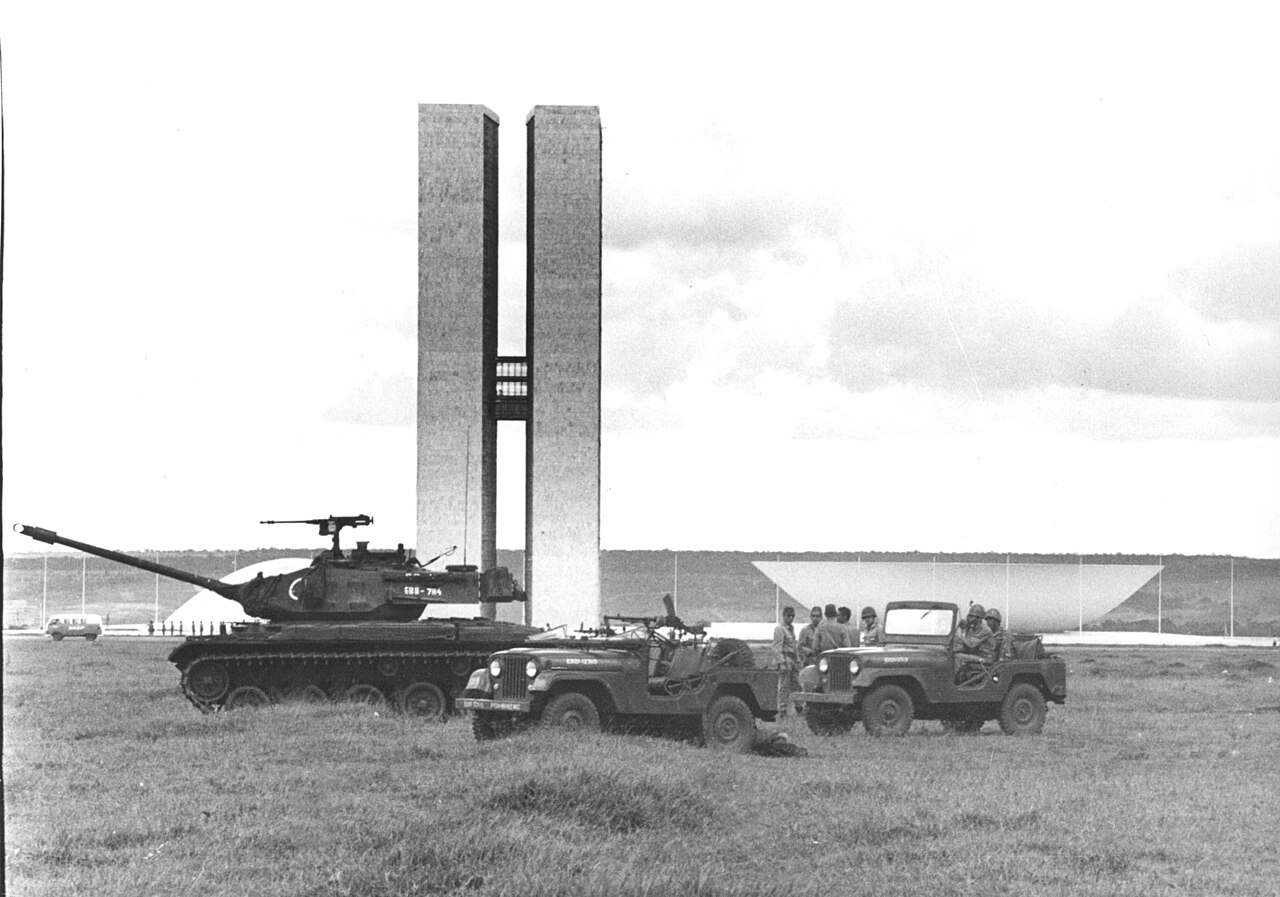
The encirclement of Palácio do Planalto by M41 Walker Bulldog tanks on April 1, 1964, marked the definitive end of the building's brief era as a symbol of democratic transparency. General Olympio Mourão Filho's troops did not need to fire upon the glass façade. President João Goulart had already vacated the premises for Porto Alegre and left the seat of power empty. The military junta that assumed control did not occupy the physical structure. They fundamentally repurposed its operational logic. Oscar Niemeyer's design emphasized visibility and lightness. The new regime demanded opacity and fortification. The ramp, intended by Niemeyer to serve as a between the people and their leader, became a controlled checkpoint. Public access ceased almost entirely.
Humberto de Alencar Castelo Branco, the of the five general-presidents, initiated the bureaucratic militarization of the executive office. His administration established the Serviço Nacional de Informações (SNI) in June 1964. While the SNI eventually constructed its own headquarters, a brutalist known locally as "Fort Apache", its nerve center remained within the third floor of Planalto. General Golbery do Couto e Silva, the chief of the SNI, operated from an office adjacent to the president. This proximity allowed the intelligence apparatus to filter all information reaching the executive. The palace transformed from an administrative center into a hub for domestic surveillance. The daily routine inside the building shifted from political negotiation to the processing of security dossiers and the ratification of Institutional Acts.
The structural transparency of the palace presented a paradox for a regime obsessed with secrecy. Security required the installation of heavy curtains and blinds to shield the interior from the vast, open plaza outside. The "Casa Militar" (Military Household) eclipsed the "Casa Civil" (Civil Household) in importance. Uniformed officers replaced civilian advisors in the corridors. The distinct clatter of boots on the marble floors became the auditory signature of the era. During the tenure of Artur da Costa e Silva, the executive branch further itself. The promulgation of Institutional Act No. 5 (AI-5) in December 1968 occurred at the Laranjeiras Palace in Rio de Janeiro, yet the enforcement of its draconian measures radiated from Brasília. The Planalto became the silent engine room where the suspension of habeas corpus and the shuttering of Congress were managed.
Emílio Garrastazu Médici's presidency (1969, 1974) represented the zenith of this isolation. Known as the "Years of Lead," this period saw the palace function as a remote command post. Médici rarely engaged with the press or the public at the palace ramp. His administration used the building to project an image of technocratic efficiency while the basement levels of other government buildings in the capital were used for interrogation. The contrast between the pristine, modernist lines of the presidential office and the violent repression occurring nationwide defined the regime's dual nature. Inside Planalto, the atmosphere was sterile and hierarchical. Access to the third floor was restricted to a tight circle of generals and technocrats who managed the "Brazilian Miracle" economic data.
Ernesto Geisel brought a shift in strategy to the executive suite starting in 1974. Working closely with Golbery do Couto e Silva, who returned to the palace as Chief of Staff, Geisel orchestrated the "slow, gradual, and secure" opening (abertura) from his desk. The palace became the site of intense internal friction between the "soft" line favoring transition and the "hard" line resisting it. Geisel used the of the presidency to dismiss his own Minister of the Army, Sylvio Frota, in 1977. This dismissal, a high-risk maneuver executed within the presidential office, prevented a chance counter-coup by hardliners. The executive power concentrated in Planalto was used, paradoxically, to the regime's absolute grip on power.
The final years of military rule under João Baptista Figueiredo saw the degradation of the palace's authority. Figueiredo, a cavalry officer with a volatile temper, famously preferred the stables at Granja do Torto to the glass office. His tenure at Planalto was marked by a loss of control over the economic emergency and the intelligence apparatus. The 1979 Amnesty Law was signed within the palace, yet the building was also the target of growing public unrest. Protesters frequently gathered at the Praça dos Três Poderes, forcing the palace security to lock down the perimeter. The "glass box" was no longer a sanctuary. It was a target.
The departure of General Figueiredo in March 1985 provided the symbol of the military's relationship with the building. Refusing to pass the presidential sash to José Sarney (who stood in for the hospitalized Tancredo Neves), Figueiredo rejected the ceremonial exit via the main ramp. He chose instead to leave through a side garage exit, avoiding the public gaze and the humiliation of the transfer of power. This "back door" departure ended twenty-one years of military occupancy. The palace they left behind was physically intact institutionally scarred, requiring years of exorcism to return to its original purpose as a civilian seat of government.
| President | Term | Key Palace |
|---|---|---|
| Humberto Castelo Branco | 1964, 1967 | Installation of the SNI apparatus within the executive wing. |
| Artur da Costa e Silva | 1967, 1969 | Closure of Congress and hardening of executive security. |
| Military Junta of 1969 | 1969 (Aug-Oct) | shared governance; palace functioned as a holding cell for power. |
| Emílio Garrastazu Médici | 1969, 1974 | Maximum isolation; "Years of Lead" managed from a closed office. |
| Ernesto Geisel | 1974, 1979 | Strategic use of executive power to enforce the "Abertura" against hardliners. |
| João Figueiredo | 1979, 1985 | of authority; exited via the garage to avoid the sash ceremony. |
Structural Restoration and Asbestos Removal 2009, 2010
By 2009, the Palácio do Planalto stood as a decaying monument to the rapid, improvised construction of Brasília. Fifty years of intense bureaucratic use had eroded the modernist purity of Oscar Niemeyer's original design. The building, inaugurated in 1960, suffered from obsolete infrastructure that posed serious safety risks to its occupants. Electrical systems were antiquated, hydraulic networks leaked, and the air conditioning system, serious in the arid Central Plateau, relied on inefficient, ozone-depleting technology. also, the interior had been disfigured by decades of ad hoc modifications, known locally as puxadinhos, where partition walls were erected to create cubicles for an ever-expanding staff. These interventions disrupted the fluid, open-plan transparency that defined the building's architectural identity.
In March 2009, President Luiz Inácio Lula da Silva authorized the detailed restoration in the palace's history. The project, budgeted initially at R$ 100 million finalizing at approximately R$ 111 million, required the complete evacuation of the building. For eighteen months, the seat of the Executive Branch moved to the Centro Cultural Banco do Brasil (CCBB), a provisional arrangement that underscored the severity of the structural interventions required. The restoration was not cosmetic; it was a surgical gutting of the building's internal organs while preserving its iconic exoskeleton.
A primary, though frequently understated, objective of the renovation was the removal of hazardous materials in the 1960s infrastructure. During the original construction, asbestos was a standard component in insulation, fireproofing, and piping. The 2009, 2010 overhaul mandated the extraction of these toxic elements, particularly within the aging air conditioning ducts and wall cavities. Specialized teams executed the removal of obsolete masonry and insulation, replacing them with modern, safe alternatives. This decontamination was essential to bring the palace into compliance with contemporary health standards, anticipating the broader national shift against asbestos that would culminate in a Supreme Court ban years later.
The engineering challenge involved replacing 100% of the electrical and hydraulic systems without altering the heritage-listed façade. Contractors installed kilometers of new cabling and piping, threading modern utilities through the slender, concrete geometry of Niemeyer's design. The central air conditioning system was entirely replaced with a high-efficiency plant, eliminating the noise and health risks of the old units. Security upgrades were equally extensive; the presidential office on the third floor received bulletproof glass, a necessary adaptation to modern threat assessments that the open idealism of 1960 had not foreseen.
Oscar Niemeyer, then 102 years old, personally approved the architectural adjustments. The restoration team, led by the curatorial and engineering departments, prioritized the demolition of the intrusive partition walls. This action returned the interior to its original vastness, reducing the number of workspaces restoring the visual continuity between the interior halls and the horizon of the Three Powers Plaza. The removal of these blocks revealed the structural elegance of the building, allowing natural light to once again penetrate the core of the administrative floors.
Parallel to the structural work, a meticulous restoration of the palace's furniture took place. The government commissioned the rehabilitation of hundreds of pieces, including iconic items designed by Sergio Rodrigues and Niemeyer himself. Tables, chairs, and fixtures that had suffered from decades of wear were stripped and refinished. Notably, the massive meeting table used by the cabinet, a Niemeyer design, was restored to its original luster. This effort aimed to reassert the "Brazilian identity" of the interior, stripping away generic office furniture that had accumulated over the years and replacing it with the modernist classics intended for the space.
| Component | Details |
|---|---|
| Total Cost | R$ 111 million (approx. US$ 56 million in 2010) |
| Duration | 18 months (March 2009 , August 2010) |
| Infrastructure | 100% replacement of electrical, hydraulic, and HVAC systems |
| Hazard Removal | Abatement of asbestos insulation and obsolete masonry |
| Parking | Expansion of underground garage to 500 spaces |
| Security | Installation of bulletproof glass in the Presidential Office |
The restoration also addressed the building's exterior. The façade, composed of concrete, glass, and marble, required cleaning and repair. The white marble, darkened by pollution and oxidation, was treated to recover its original brightness. The reflecting pool, a security feature added in 1991 after a bus hijacking attempt, was drained and waterproofed. These external works ensured that the visual impact of the "floating" columns remained undiminished.
On August 25, 2010, the Palácio do Planalto reopened. The result was a building that looked identical to its 1960 inauguration on the outside functioned as a 21st-century on the inside. The restoration successfully extended the operational life of the structure, resolving the "sick building" syndrome caused by the decaying asbestos-laden infrastructure. It stood as a rare example of a public works project in Brazil that balanced strict heritage preservation with the aggressive modernization required for the seat of national power.
Presidential Guard Battalion and Perimeter Defense

| Era | Primary Defense Doctrine | Physical blocks | Surveillance Tech | Troop Posture |
|---|---|---|---|---|
| 1960, 2013 | Symbolic Deterrence | Mirror of Water, Ramp Elevation | Analog CCTV (Minimal) | Ceremonial (BGP/Dragões) |
| 2013, 2022 | Reactive Crowd Control | Temporary Metal Fencing (Grades) | Digital CCTV (44 cameras) | Riot Control Squads on Standby |
| Jan 8, 2023 | widespread Failure | None (Fences Removed) | Compromised/Blind Spots | Hesitant/Under-equipped |
| 2024, 2026 | Integrated Area Denial | Armored Glass (Ground Floor), Modular blocks | AI Facial Recognition (348+ cameras) | Tactical Reserve On-Site (Galpão) |
Curated Art Inventory and Furniture Assets
The interior curation of Palácio do Planalto was never a mere exercise in decoration; it functioned as a rigid ideological extension of the building's architectural manifesto. When Oscar Niemeyer designed the structure, he entrusted the interior assets to his daughter, Anna Maria Niemeyer. Her mandate was absolute: the furniture and art must reflect the same modernist rupture as the concrete curves outside. Consequently, the inventory established in 1960 rejected the heavy, velvet-draped aesthetic of the previous capital in Rio de Janeiro. Instead, it prioritized Brazilian modernism, utilizing materials like jacaranda wood, leather, and chrome to mirror the nation's industrial ambitions. This curated exclusion of the past makes the presence of the collection's single greatest anomaly, the 17th-century Balthazar Martinot clock, all the more significant.
The Balthazar Martinot clock stands as the only piece of baroque heritage permitted within the modernist sanctuary of the third floor. Manufactured during the reign of Louis XIV by the king's own clockmaker, the piece features elaborate Boulle marquetry, a technique using tortoise shell and brass. Its provenance traces back to a diplomatic gift from the French Court to Dom João VI, arriving in Brazil with the Portuguese Royal Family in 1808. For over two centuries, it survived the humidity of Rio de Janeiro and the transfer to Brasília. Its survival ended, temporarily, on January 8, 2023. During the invasion of the palace, rioters threw the clock to the ground, shattering the case and destroying the method. The restoration required a diplomatic intervention; because no specialist in Brazil possessed the expertise to repair the Boulle marquetry, the Swiss government and the manufacturer Audemars Piguet stepped in. The artifact returned to the palace only in January 2025, following two years of microscopic reconstruction.
In contrast to the clock, the painting collection focuses heavily on the mid-20th century, serving as a visual timeline of Brazil's artistic maturation. The most valuable canvas in the building is As Mulatas (1962) by Emiliano Di Cavalcanti. Valued between R$ 8 million and R$ 15 million, the work dominates the Noble Room. It became a primary target during the 2023 attacks, sustaining seven distinct punctures from a sharp object. The violence against this specific piece was not random; it represented an assault on the cultural identity Di Cavalcanti championed, a syncretic, tropical modernism that the attackers sought to erase. Restoration teams from the Federal University of Pelotas (UFPel) and the National Institute of Historic and Artistic Heritage (IPHAN) spent months performing chromatic reintegration to repair the tears without erasing the historical record of the damage.
The inventory also serves as a barometer for the political climate within the executive branch. This is most clear in the history of Os Orixás (1966) by Djanira da Motta e Silva. The large- painting depicts three deities of Candomblé, Iansã, Oxum, and Nanã, and hung prominently in the Salão Nobre for decades. In 2019, the administration of Jair Bolsonaro removed the work, citing "museological rotation," though internal reports confirmed the removal stemmed from religious intolerance driven by the administration's evangelical base. The painting spent four years in storage, hidden from view. Its return to the main wall in January 2023, immediately following the transition of power, signaled a reassertion of the secular, pluralistic state mandate originally envisioned by the capital's founders.
Furniture assets in the palace follow the strict "Anna Maria" standard. The inventory includes seminal works by Sergio Rodrigues, whose "Tião" chairs and "Mole" armchairs introduced a relaxed, vernacular comfort to the rigid glass box of the palace. The "Marquesa" bench, designed by Oscar Niemeyer himself in collaboration with his daughter, exemplifies the integration of architecture and furniture; its curves mimic the building's columns. Unlike the art, much of the furniture suffered less from direct vandalism and more from the chaotic barricading of doors during the 2023 riots. yet, the sheer volume of damaged items, over 700 pieces cataloged by IPHAN, forced a massive conservation effort that continued well into 2026.
Sculptural works faced the most brutal physical force. O Flautista, a bronze sculpture by Bruno Giorgi valued at R$ 250, 000, was found in fragments. Giorgi, who also sculpted the iconic Os Candangos in the Praça dos Três Poderes, created O Flautista to evoke lightness and melody. The attackers smashed it until it snapped at the base and the neck. Another casualty was the wood sculpture by Frans Krajcberg, an artist known for using scorched wood to protest environmental destruction. Rioters broke the branches of his work, ironically completing the pattern of destruction the artist originally critiqued. By March 2026, while the bronze works had been reassembled, wooden pieces retained the scars of the attack as a deliberate curatorial choice to memorialize the event.
The financial load of this destruction fell on the public treasury, although international partnerships alleviated specific high-cost items like the Martinot clock. The initial damage assessment in 2023 estimated costs exceeding R$ 4 million for art restoration alone, a figure that does not account for the historical value lost. The table details the status of key assets as of early 2026, reflecting the completion of the major restoration pattern initiated in 2024.
| Asset Name | Artist / Maker | Origin / Era | 2023 Damage Description | 2026 Status |
|---|---|---|---|---|
| Balthazar Martinot Clock | Balthazar Martinot (Louis XIV) | France, c. 17th Century | Case shattered, method destroyed, statue detached. | Restored (Swiss Partnership). Returned Jan 2025. |
| As Mulatas | Emiliano Di Cavalcanti | Brazil, 1962 | 7 punctures/tears in canvas. | Fully Restored. Rehung in Noble Room. |
| Os Orixás | Djanira da Motta e Silva | Brazil, 1966 | None (in storage during attack). | Returned to display (Political reinstatement). |
| O Flautista | Bruno Giorgi | Brazil, c. 1960s | Bronze smashed, broken into fragments. | Reassembled. Visible weld lines retained. |
| Wooden Sculpture | Frans Krajcberg | Brazil, 20th Century | Branches broken, structural cracks. | Stabilized. losses permanent. |
| Marquesa Bench | Oscar & Anna Maria Niemeyer | Brazil, Modernist | Upholstery slashed, wood scratched. | Restored. In use. |
| Tião Chairs | Sergio Rodrigues | Brazil, Modernist | Broken frames, water damage. | Restored or replaced with reserve inventory. |
| Atos Bulcão Wall Panel | Atos Bulcão | Brazil, Modernist | Minor chips, smoke residue. | Cleaned and Conserved. |
The restoration process revealed a widespread vulnerability in the palace's asset management: the absence of a dedicated, climate-controlled reserve for high-value items during crises. Following the return of the restored works in 2025, the curatorial department implemented new. These include rapid-response crating for the Di Cavalcanti and the installation of ballistic glass shields for the Martinot clock. The collection, once an open display of democratic transparency, exists behind reinforced blocks, a physical manifestation of the state's defensive posture in the post-2023 era.
The Parlatório and Official State Communication Infrastructure
The Parlatório stands as the most visible interface between the Brazilian executive and the public, a marble monolith designed by Oscar Niemeyer to formalize the separation between ruler and ruled. Located to the left of the main entrance, this speaker's platform breaks the horizontal symmetry of the façade, jutting out as a solitary block of white stone. Unlike the balconies of the Paço Imperial in Rio de Janeiro, where colonial governors and emperors addressed crowds from within the safety of the building's main volume, the Parlatório exposes the President to the open air of the Praça dos Três Poderes. It functions not as a podium as an altar of state authority, used almost exclusively for presidential inaugurations. The structure demands a ritualistic performance: the President must exit the secure interior, walk the outdoor ramp, and stand elevated above the masses. This architectural choice enforces a visual hierarchy that dates back to absolute monarchies, yet it is rendered in the clear, unadorned concrete of modernism.
Beneath the ceremonial surface of the Parlatório lies the operational nervous system of the palace: the Comitê de Imprensa (Press Committee). Situated on the ground floor, this area was designed to house the "setoristas", journalists permanently assigned to cover the presidency. For decades, this physical proximity allowed for a controlled osmosis of information. Reporters worked in an environment frequently described as an "aquarium," separated from the official halls by glass and protocol. yet, the analog era of press releases and radio broadcasts, which defined the communication strategy from 1960 through the democratization of the 1980s, collapsed with the rise of digital warfare in the 2010s. The physical infrastructure of the press room became a target during the January 8, 2023, insurrection. Rioters did not just smash equipment; they urinated and defecated in the workspaces of the press, a visceral act of rejection against the traditional media apparatus that the room represented.
The true shift in state communication power occurred on the third floor, far removed from the ground-level press room. Federal Police investigations and Supreme Federal Court (STF) inquiries identified this level as the operational base for the so-called "Gabinete do Ódio" (Hate Cabinet) during the 2019, 2022 administration. Investigators detailed how state resources, official computers, secure networks, and paid advisors, were allegedly repurposed to manage algorithmic disinformation campaigns. Unlike the Parlatório, which relies on public visibility, this infrastructure operated on opacity. The of the state was turned inward, using the palace's own high-speed connections to coordinate attacks on political opponents and democratic institutions. This weaponization of the building's digital infrastructure marked a departure from the passive transparency Niemeyer envisioned; the glass walls remained, the data flowing through them became a tool of subversion.
The vulnerability of this infrastructure was exposed during the 2023 attacks. The mob breached the palace and looted weapons from the Institutional Security Bureau (GSI), they also severed serious communication lines. They stole hard drives, smashed cameras, and destroyed fiber optic cables, blinding the central command for hours. The damage forced a total overhaul of the palace's defensive and communicative architecture. By 2024, the number of surveillance cameras had surged from 68 to 708, a tenfold increase intended to eliminate blind spots. The government also initiated the installation of anti-drone technology and frequency jammers to prevent aerial surveillance or remote detonation devices from method the ramp or the Parlatório.
By 2026, the Palácio do Planalto had transformed into a digital. The Brazilian Intelligence Agency (ABIN) began integrating post-quantum encryption to secure presidential communications against future decryption threats. The ground-floor glass, once a symbol of democratic openness, was scheduled for replacement with heavy-duty armored panels capable of withstanding high-caliber ballistic impacts. This "bunkerization" of the palace reflects a grim acceptance that the seat of power is no longer just an administrative center a contested territory in a permanent hybrid war. The Parlatório remains for the cameras, the real governance occurs behind of digital firewalls and reinforced concrete, completely severed from the open square.
| Era | Primary Interface | Key Infrastructure | Security Doctrine |
|---|---|---|---|
| 1960, 1985 | Radio & Print | Comitê de Imprensa (Ground Floor), Telex machines | Physical access control; Censorship (Dictatorship era) |
| 1985, 2010 | Television | Satellite uplinks, The "Aquarium" press room | Institutional transparency; Proximity of press to power |
| 2010, 2022 | Social Media | "Gabinete do Ódio" (3rd Floor), High-speed fiber | Information warfare; Algorithmic manipulation |
| 2023, 2026 | Secure Digital | Post-quantum encryption, 708 CCTV cameras | Fortification; Anti-drone systems; Armored glazing |
January 8 Storming and Documented Vandalism 2023
The security perimeter of the Palácio do Planalto collapsed at approximately 15: 00 on January 8, 2023. A mob of rioters, refusing to accept the results of the 2022 general election, ascended the iconic ramp designed by Oscar Niemeyer and breached the seat of executive power. This event marked the most significant physical violation of the building since its inauguration in 1960. The invaders shattered the glass facade that defines the transparency of the modernist structure. They gained access to the ground floor, the second floor, and the third floor where the presidential office is located. While the President's personal office remained secure behind armored glass, the surrounding ceremonial spaces suffered catastrophic damage. The destruction was not structural. It targeted the curated collection of artistic and historical artifacts that represent the Brazilian state's continuity from the colonial era to the present day.
The most historically significant casualty of the invasion was the Balthazar Martinot clock. This 17th-century timepiece was a gift from the French court of Louis XIV to Dom João VI. It arrived in Brazil in 1808 with the transfer of the Portuguese royal family. Martinot was the royal clockmaker to the Sun King. Only two such clocks by Martinot exist in the world. The other resides in the Palace of Versailles. Rioters threw the artifact to the floor from a console table on the third floor. The impact shattered the Boulle-style case and severely damaged the internal method. The statue of Neptune that surmounted the piece was severed. Early assessments by the National Institute of Historic and Artistic Heritage (IPHAN) described the damage as "very serious" and chance irreversible. The restoration required an international cooperation agreement involving Swiss experts and the manufacture of specific components that had not been produced for centuries. The clock returned to the palace in January 2025 after a meticulous reconstruction process.
Modernist masterpieces housed within the Noble Room faced direct aggression. The painting "As Mulatas" by Emiliano Di Cavalcanti, a seminal work of Brazilian modernism valued between R$ 8 million and R$ 20 million, was stabbed seven times. The attackers used sharp objects to puncture the canvas in multiple locations. This painting is the central piece of the Noble Room and has hung there since the palace's construction. Restorers from the Federal University of Pelotas (UFPel) worked for months to repair the tears. They chose to leave the scars visible on the verso of the canvas as a historical record of the violence. The front of the painting was fully reintegrated visually. The decision to maintain the damage on the back serves as a curatorial statement on the vulnerability of democratic institutions.
The destruction extended to the gallery of former presidents. Rioters tore photographs from the walls and smashed the frames. This act represented a symbolic attempt to erase the political history of the republic. On the ground floor, the large painting "Bandeira do Brasil" by Jorge Eduardo was ripped from the wall. The invaders activated the building's fire hydrants and flooded the floor. The artwork was found floating in a pool of water. The water damage required immediate emergency conservation to prevent mold and warping of the chassis. The flooding also damaged the carpet and the wooden flooring of the lower levels. Furniture designed by Sérgio Rodrigues and Anna Maria Niemeyer suffered broken legs and torn upholstery. The desk of former President Juscelino Kubitschek, used as a ceremonial object, was overturned and used as a barricade against security forces.
Security failures at the Palácio do Planalto were total. The Institutional Security Bureau (GSI), responsible for the safety of the presidency, failed to prevent the breach. Video footage released later showed GSI agents inside the palace during the invasion. agents appeared to interact passively with the rioters. Others abandoned their posts as the mob surged through the corridors. The absence of active resistance allowed the vandals to roam the building for hours. They destroyed equipment, stole weapons from the GSI armory, and urinated in the corridors. The absence of a strong defense strategy for the palace, even with intelligence reports warning of chance unrest, became a central subject of the subsequent Parliamentary Commission of Inquiry (CPMI).
The restoration effort mobilized a task force of curators, conservators, and university researchers. IPHAN coordinated the recovery of the building's architectural integrity. The total cost of the damage to the Three Powers (Executive, Legislative, and Judiciary) exceeded R$ 20 million. The specific damage to the Planalto Palace art collection accounted for of this figure due to the high market value of the modernist works. By 2026, the palace had fully returned to operational status. The security were overhauled to include reinforced blocks and a reorganized GSI. The physical scars of the building were repaired. Yet the memory of the event remains in the restored artifacts.
| Artifact | Artist / Origin | Historical Era | Damage Description | Restoration Status (2026) |
|---|---|---|---|---|
| Balthazar Martinot Clock | Balthazar Martinot (France) | 17th Century (Baroque) | Case shattered, method destroyed, statue severed. | Fully restored via Swiss partnership. Returned Jan 2025. |
| As Mulatas | Emiliano Di Cavalcanti | 1962 (Modernism) | Seven punctures/stabs to the canvas. | Restored. Scars preserved on verso. Returned Jan 2025. |
| Bandeira do Brasil | Jorge Eduardo | 1995 (Contemporary) | Water damage, ripped from wall. | Restored and reinstalled. |
| O Flautista | Bruno Giorgi | 1962 (Modernism) | Bronze sculpture shattered into fragments. | Restored. |
| Frans Krajcberg Sculpture | Frans Krajcberg | 20th Century | Wood branches broken and discarded. | Restored using original fragments. |
| JK's Desk | Oscar Niemeyer / Anna Maria Niemeyer | 1960 (Modernism) | Used as barricade, scratched, structural damage. | Restored. |
| Gallery of Presidents | Various Photographers | Republican Era | Photographs torn, frames smashed. | Replaced and reinstalled. |
The response to the vandalism required a technical operation of high complexity. The laboratory set up for the restoration became a temporary institution within the palace itself. Specialists worked on site to minimize the movement of fragile works. The recovery of the "Bandeira do Brasil" painting involved drying processes to extract moisture without shrinking the canvas. The bronze sculpture "O Flautista" by Bruno Giorgi, which the mob smashed into pieces, required metallurgical reconstruction. The fragments were collected by cleaning crews who swept the debris after the police retook the building. These fragments were cataloged and reassembled. The fact that cleaning staff saved these pieces prevented the total loss of the sculpture. This detail shows the chaotic nature of the aftermath where debris and art were intermingled on the flooded floors.
The invasion of the Palácio do Planalto on January 8 stands as a singular event in the history of the republic. It differs from the military coups of the past which were conducted by organized armed forces seizing control of the state apparatus. This was a chaotic mass event characterized by the destruction of symbols rather than the strategic occupation of key infrastructure. The rioters did not attempt to hold the building for governance. They sought to degrade it. The choice to destroy the Balthazar Martinot clock and the Di Cavalcanti painting reveals an aggression toward the cultural identity of the state. The palace, designed by Niemeyer to project an image of order and progress, became the stage for a performance of disorder. The restoration of the building and its contents was completed by 2025. The physical evidence of the attack has been erased from the main halls. the security posture of the Brazilian presidency has shifted permanently from an open-access philosophy to one of defensive fortification.
Security Fortification and Surveillance Upgrades 2023, 2026

The January 8, 2023, insurrection dismantled the security doctrine that had governed Palácio do Planalto since its inauguration. For nearly two centuries, from the Marquis of Pombal's 1761 interiorization proposal to the 1950s construction, the primary defense of Brazil's capital was geographic isolation. Oscar Niemeyer designed the palace in 1958 under the assumption that the distance from population centers and the symbolic transparency of democratic power would serve as sufficient protection. The 2023 breach, where rioters shattered the ground-floor glass façade with sticks and stones, proved this architectural philosophy obsolete. In the aftermath, the Lula administration initiated the "Shield of Planalto," a multi-year fortification program that prioritizes ballistic hardening and digital omniscience over aesthetic openness.
The most visible alteration to the palace involves the retrofitting of its iconic glass perimeter. Niemeyer's original tempered glass, designed to dissolve the barrier between the ruler and the people, offered zero resistance to the mob. In late 2023, the Gabinete de Segurança Institucional (GSI) secured a budget of approximately R$ 8 million to replace the entire ground-floor glazing with armored panels (blindagem). This project faces bureaucratic friction with the Instituto do Patrimônio Histórico e Artístico Nacional (IPHAN), which mandates that the visual lightness of the heritage site remain unaltered. Even with these heritage constraints, the GSI proceeded with the installation of ballistic glass in the presidential cabinet on the third floor and hydraulic bollards at the base of the ramp to prevent vehicular ramming attacks.
Surveillance capabilities underwent a radical expansion between 2023 and 2025. On the day of the attacks, the palace operated with a legacy system of roughly 44 to 68 analog cameras, of which were blind to serious angles or easily disabled by intruders. By 2025, the government completed the installation of 708 high-definition cameras across the Planalto, Alvorada, and Jaburu complexes. This new network, costing an estimated R$ 10. 7 million, integrates facial recognition technology capable of identifying individuals against databases held by the Federal Police and the Brazilian Intelligence Agency (ABIN). The system provides 180-degree panoramic coverage and eliminates the blind spots that rioters exploited to access the upper floors.
The institutional architecture of presidential security also shifted from a military monopoly to a hybrid police-military model. Following the resignation of General Gonçalves Dias, who was filmed interacting passively with rioters, President Lula signed decrees stripping the GSI of its exclusive control over the president's immediate safety. The creation of the Secretariat of Presidential Security (SESP), led by the Federal Police, introduced a civilian law enforcement to the inner perimeter. Although the GSI regained authority over the facility's physical security under General Marcos Amaro in mid-2023, the changed. The military contingent at the palace increased by nearly 60% by 2024, and the Batalhão da Guarda Presidencial adopted aggressive crowd control tactics previously deemed unnecessary for the administrative seat.
Cybersecurity emerged as the third pillar of the post-2023 fortification. The physical breach exposed the vulnerability of the palace's digital infrastructure to data theft and sabotage. In response, the administration enacted Decree 11. 856 in December 2023, establishing the National Cybersecurity Policy (PNCiber). This framework mandates rigorous encryption standards and air-gapped backups for the Planalto's internal networks. The palace also deployed anti-drone jamming systems capable of intercepting unauthorized unmanned aerial vehicles (UAVs) within the Praça dos Três Poderes airspace, a direct response to the proliferation of consumer drones used for surveillance by hostile actors.
| Security | Status: January 2023 (Pre-Attack) | Status: March 2026 (Post-Fortification) |
|---|---|---|
| Perimeter Glazing | Standard tempered glass (shatter-prone) | Ballistic armored panels (Ground Floor/Cabinet) |
| Surveillance Grid | ~68 Analog Cameras (Low resolution) | 708 AI-Enabled Cameras (Facial Recognition) |
| Vehicle Control | Manual checkpoints | Hydraulic rising bollards (Anti-ramming) |
| Airspace Defense | Restricted flight zone (Passive) | Active anti-drone jamming & interdiction |
| Command Structure | GSI (Military) Exclusive Control | Hybrid: GSI (Facility) + Federal Police (Personal) |
| Riot Control | Reactive deployment (delayed) | Pre-staged shock troops & rapid response units |
The cost of these upgrades reflects the severity of the threat. While the immediate repair of physical damage, including the restoration of ruined artwork like the Balthasar Martinot clock, cost approximately R$ 2. 5 million, the structural hardening and technological modernization exceeded R$ 20 million by 2025. This expenditure marks a permanent departure from the "citizen palace" ideal. The removal of the metal fences (grades) in May 2023 was a symbolic gesture by Lula to project normalcy, yet the invisible wall of biometric surveillance and armored infrastructure remains thicker than ever. The security apparatus operates on the premise that the capital's interior location, once its primary defense, is irrelevant in an era of mobilized domestic extremism.
By 2026, the Palácio do Planalto functions less as an open administrative center and more as a hardened command bunker disguised within Modernist architecture. The integration of the G20 security in late 2024 further tested these systems, employing the Guarantee of Law and Order (GLO) to deploy thousands of troops and synchronize military assets with the new palace defenses. This event served as the final validation of the upgrades, confirming that the seat of Brazilian executive power can no longer rely on the passive respect of the citizenry must enforce its sanctity through kinetic and digital blocks.
Office Allocation and Third Floor Decision Centers
| Office / Unit | Floor | Function & Proximity to Power |
|---|---|---|
| Gabinete Presidencial | 3rd | The President's private workspace. The decision node. Contains the secure meeting room and the restored Di Cavalcanti mural. |
| Gabinete Pessoal | 3rd | Immediate support staff. Controls the President's agenda and physical access. Includes the private secretaries. |
| Ajudância de Ordens | 3rd | Military aides (Army, Navy, Air Force) who provide 24/7 assistance and carry secure comms. Located adjacent to the President. |
| Gabinete da Primeira-Dama | 3rd | Office of Rosângela da Silva (Janja). Focuses on social agendas and cultural affairs. Represents a break in traditional allocation. |
| Casa Civil (Chief of Staff) | 4th | The operational engine of the government. Filters technical demands before they reach the President. Occupied by Rui Costa (2023-2026). |
| GSI (Institutional Security) | 4th | Responsible for palace security and intelligence. Coordinates with the Federal Police detail on the 3rd floor. |
| Secretaria-Geral | 4th | Handles administrative and legal processing of presidential acts. The bureaucratic gatekeeper. |
| Salão de Espera (Mezzanine) | 3rd | The holding area for ministers and foreign dignitaries. Houses the Balthazar Martinot clock and major art pieces. |
The restoration of the Third Floor following the 2023 attacks cost the public coffers millions, the symbolic cost was higher. The shattering of the glass facade and the destruction of the interior forced a hardening of the "glass box." By 2026, while the transparency of Niemeyer's architecture remains, the operational reality is one of heightened surveillance and fortified access, turning the Third Floor into a within a showcase. The decision centers here do not just direct policy; they also constantly monitor the physical security of the Republic's core.
Maintenance Costs and Utility Consumption Metrics
The financial footprint of Palácio do Planalto extends far beyond its initial construction budget, evolving into a complex ledger of preservation, utility consumption, and emergency repairs. While the site incurred zero expense to the treasury between 1700 and 1956, remaining an empty expanse of the Goiano Plateau, the shift of the capital to Brasília introduced a permanent, high-cost asset to the federal balance sheet. Since its inauguration in 1960, the building has operated as a "glass box" in a tropical savanna, a design choice that aggressive climate control and constant exterior maintenance to combat the red dust of the Central Plateau.
Modern maintenance data reveals that the transparency of Oscar Niemeyer's design comes with a steep price tag. The extensive use of glass façades creates a greenhouse effect, demanding industrial- air conditioning systems that dominate the building's energy profile. In the period between January 2023 and January 2026, the maintenance of presidential palaces, with Planalto as the primary cost center, consumed over R$ 8. 4 million. This figure excludes the salaries of the extensive staff required to polish the marble, clean the glass, and manicure the grounds. Specific data for 2025 indicates that Planalto alone required approximately R$ 1. 06 million for basic conservation of its physical structure and internal systems, a number that rises significantly when aggregated with the Alvorada and Jaburu residences.
The most significant single-event expenditure in the building's recent history occurred between 2009 and 2010. A massive restoration project, initiated under President Luiz Inácio Lula da Silva, stripped the building to its concrete shell to replace obsolete electrical wiring, plumbing, and the central air conditioning system. The final bill for this intervention reached R$ 111 million. This overhaul addressed decades of wear also installed modern data infrastructure that increased the building's baseline energy consumption. Unlike the colonial seats of power in Rio de Janeiro, which relied on passive cooling and thick masonry, Planalto functions as a sealed machine dependent on the electrical grid.
Utility consumption metrics from 2019 to 2025 demonstrate the of resources required to keep the presidency operational. Between January 2023 and August 2025, the water bill for the presidential complex, including Planalto, Alvorada, and Granja do Torto, totaled R$ 13 million. This represents a marked increase from the R$ 12. 4 million spent during the entire four-year term of Jair Bolsonaro (2019, 2022). The spike in water usage, particularly in 2024 and 2025, correlates with intensified landscaping efforts and the reactivation of water features that had been drained or neglected. Electricity costs follow a similar upward trajectory, driven by tariff increases and the thermal of the modernist architecture during increasingly hot summers in the Federal District.
The events of January 8, 2023, introduced a new category of expense: insurrection damage repair. The immediate structural recovery of the ground floor, including the replacement of broken glass plates, elevator repairs, and door reconstruction, cost the treasury R$ 297, 730. 46. Yet, this figure masks the true cost of the vandalism. The restoration of destroyed or damaged artworks, such as the Di Cavalcanti mural and the 17th-century Balthazar Martinot clock, required specialized labor from the Federal University of Pelotas and Iphan. By January 2025, the specific budget for restoring these 21 artistic items exceeded R$ 2. 2 million. The total economic impact of the attack on the Planalto building, when factoring in the loss of patrimonial value, was estimated at R$ 4. 3 million.
Spending on furniture and decoration also surged in the 2023, 2024 period, drawing intense public scrutiny. The federal government allocated R$ 26. 8 million for renovations and furnishings across the presidential palaces in 2023, the highest amount in years. Specific acquisitions for Planalto included a R$ 114, 000 rug inspired by Burle Marx designs, intended to replace worn coverings in ceremonial areas. Critics pointed to the purchase of a R$ 65, 000 sofa and a R$ 42, 000 bed as evidence of fiscal looseness, though the administration argued these were necessary replacements for assets left in disrepair by the previous occupant. This pattern of neglect and expensive replenishment characterizes the long-term management of the palace's inventory.
Security upgrades planned for 2026 project further heavy spending. Following the vulnerability exposed by the 2023 riots, the Gabinete de Segurança Institucional (GSI) proposed the installation of armored glass on the ground floor. The estimated cost for this "blindagem" stands at R$ 8 million. The project faced delays due to the need for approval from Iphan, as the alteration affects the tombado (heritage-listed) façade of the monument. This expenditure reflects a shift in the building's function from an open symbol of democracy to a hardened bunker, a transformation that carries both a financial and symbolic cost.
| Period/Year | Category | Cost (BRL) | Details |
|---|---|---|---|
| 2009, 2010 | General Restoration | 111, 000, 000 | Complete overhaul of HVAC, electrical, and hydraulic systems. |
| 2019, 2022 | Water Utility (4 Years) | 12, 459, 635 | Total water consumption for Planalto, Alvorada, and Torto. |
| 2023 (Jan) | Structural Repair | 297, 730 | Immediate repairs after Jan 8 riots (glass, elevators, doors). |
| 2023 | Furniture & Decor | 26, 800, 000 | Total for all palaces; includes R$ 114k rug and R$ 65k sofa. |
| 2023, 2025 | Water Utility (2. 5 Years) | 13, 000, 000 | Water consumption under Lula III administration (Jan '23, Aug '25). |
| 2025 | Art Restoration | 2, 200, 000 | Recovery of 21 artworks damaged in riots (via UFPel/Iphan). |
| 2026 (Est.) | Security Upgrade | 8, 000, 000 | Projected cost for armored glass installation on ground floor. |
The operational logic of Palácio do Planalto remains trapped between its status as a museum and its function as a working office. The cost of cleaning the windows alone involves specialized contracts that run into the millions annually, as the glass must be kept pristine to maintain the architectural illusion of weightlessness. Unlike the Paço Imperial in Rio, which required simple masonry repairs, Planalto demands high-tech stewardship. As the building ages past its 65th year in 2026, the tension between preserving Niemeyer's aesthetic and the financial reality of maintaining a glass monolith in the central Brazilian sun continues to drive the federal budget upward.