
Andrea Tirali’s 1723 Paving: Trachyte and Istrian Stone Durability
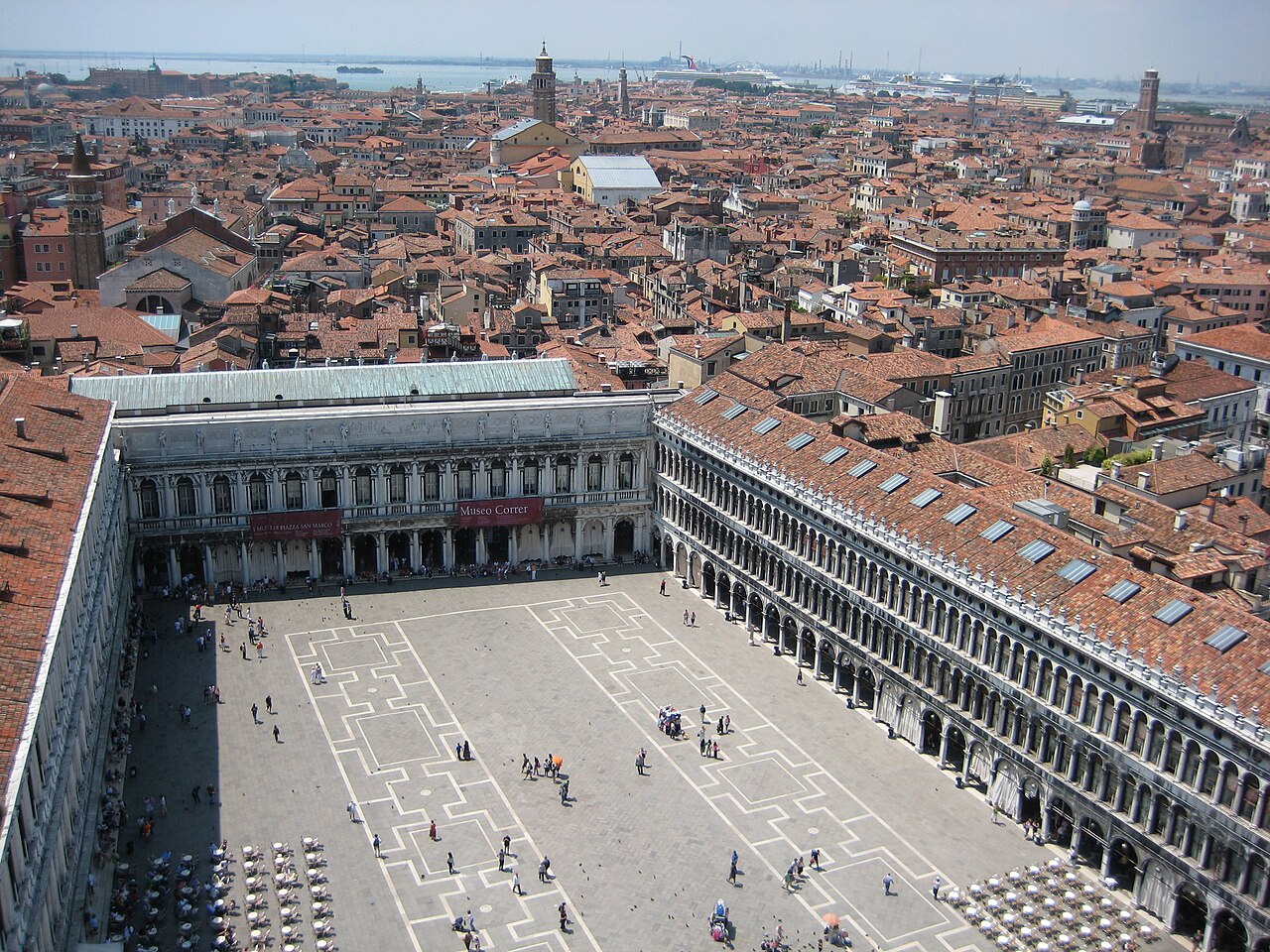
Andrea Tirali's 1723 redesign of the Piazza San Marco pavement marked a definitive shift in Venetian urban engineering. Before this intervention the square used a brick herringbone pattern known as a spina di pesce. This earlier surface proved too fragile for the intensifying commercial traffic and ceremonial processions of the Serene Republic. Tirali replaced the decaying brick with a complex geometric grid that remains the visual signature of the Piazza today. His design raised the grade of the square to combat the frequent incursions of the era. The architect selected two distinct lithotypes to execute this vision: grey trachyte for the field and white Istrian stone for the geometric bands.
The primary surface consists of trachyte blocks known locally as masegni. These stones originate from the Euganean Hills near Padua. Volcanic in origin, Euganean trachyte possesses a density of approximately 2530 kg/m³ and a compressive strength ranging between 175 and 192 MPa. This material offers superior resistance to mechanical wear compared to the sedimentary rocks used elsewhere in the lagoon. The rough surface texture of the trachyte provides necessary friction for pedestrians during wet conditions. Historical records indicate the original 18th-century masegni were cut as thick, pyramidal blocks with a depth of 10 to 15 centimeters. This shape allowed them to be driven into the underlying sand and clay substrate to form a stable, interlocking surface.
Tirali interrupted the grey volcanic field with bands of Istrian stone. This dense limestone is composed primarily of calcium carbonate and was quarried from the Istrian peninsula. The white bands serve a dual purpose. Aesthetically they create a false perspective that elongates the perceived size of the Piazza. Functionally they acted as logistical markers for the market stalls that once occupied the square. The specific placement of these bands areas for different guilds. Shoemakers and clog makers had specific zones defined by the stone layout. While Istrian stone is impermeable and physically strong it remains chemically to sulfation. Pollutants react with the calcite to form black gypsum crusts which eventually exfoliate and lead to material loss.
The durability of this 1723 system faces severe challenges from the lagoon environment. Salt crystallization constitutes the primary method of decay. When saline water from high saturates the porous trachyte it deposits halite crystals within the stone matrix upon evaporation. These crystals expand and exert internal pressure that exceeds the tensile strength of the rock. This process causes the surface to flake and crumble in a phenomenon called sub-florescence. The white Istrian stone suffers less from internal crystallization degrades rapidly when exposed to acidic atmospheric pollutants. The combination of rising sea levels and land subsidence has accelerated these decay pattern over the last three centuries.
| Property | Euganean Trachyte (Grey) | Istrian Stone (White) |
|---|---|---|
| Origin | Volcanic (Euganean Hills) | Sedimentary Limestone (Istria) |
| Density | ~2530 kg/m³ | ~2600-2700 kg/m³ |
| Porosity | 10-19% | <1% |
| Primary Decay Mode | Salt Crystallization / Spalling | Sulfation / Black Crusts |
| 1723 Function | Main Paving Field | Geometric Markers / Drainage |
Modern maintenance practices have altered the structural integrity of the pavement. Restoration projects managed by Insula S. p. A. frequently replace damaged historical masegni with new quarried stone. The supply of high-quality Euganean trachyte is finite. Consequently recent replacement blocks frequently absence the depth of the 18th-century originals. Contemporary slabs are frequently cut to a thickness of only 3 to 5 centimeters. These thinner stones rely entirely on the sand bed for stability rather than their own mass and shape. This reduction in material volume makes the modern surface more prone to displacement under the weight of heavy or crowd surges.
The operational status of the MOSE flood barrier system in 2025 and 2026 introduces a new variable to the conservation of the pavement. By preventing extreme high the blocks reduce the frequency of complete saltwater immersion. This reduction in saturation events may slow the rate of salt accumulation within the stone pores. Yet the blocks do not stop the capillary rise of dampness from the subsoil. The masegni continue to absorb moisture from. This moisture carries dissolved salts that crystallize near the surface during dry periods. Conservationists that while MOSE prevents catastrophic flooding it does not eliminate the chronic chemical weathering that eats away at Tirali's work.
Recent restoration efforts in 2024 and 2025 focused on the "Insula di San Marco" project. This initiative involves lifting large sections of the pavement to repair the drainage channels known as catoini. Workers clean the individual stones and reset them to correct differential settlement. The project aims to restore the subtle camber of the square which directs rainwater toward the drains. Even with these interventions the Piazza remains a patchwork of original 1723 stones and modern replacements. The visual continuity of Tirali's design the physical fabric requires constant and costly surgical intervention to survive the hostile lagoon climate.
Napoleonic Occupation and Architectural Reconfiguration (1797, 1814)
The collapse of the Venetian Republic on May 12, 1797, was not a political surrender. It initiated a period of aggressive architectural surgery that permanently altered the Piazza San Marco. Napoleon Bonaparte did not view the square as a sacred relic of the Serene Republic. He saw it as a construction site for his own imperial ambition. His troops entered the city and immediately began a systematic campaign to strip the Piazza of its republican symbols. On June 4, 1797, French forces erected a "Tree of Liberty" in the center of the square. This event served as the backdrop for the ritual burning of the Libro d'Oro, the Golden Book that listed the Venetian nobility, and the ducal insignia. The psychological violation of the space preceded the physical demolition.
The most visible scar from this era remains the western side of the Piazza. For centuries, the Church of San Geminiano stood opposite the Basilica di San Marco. This structure, finalized by the renowned architect Jacopo Sansovino in 1557, linked the Procuratie Vecchie and the Procuratie Nuove. It was a jewel of the High Renaissance and anchored the square's visual balance. Napoleon the Procuratie Nuove as the Royal Palace for his stepson Eugène de Beauharnais, the Viceroy of the Kingdom of Italy. The existing structures were deemed insufficient for a monarchical residence. The Emperor required a ballroom and a monumental entrance that would unify the north and south ranges of the square. In May 1807, the French administration ordered the demolition of San Geminiano.
The destruction of Sansovino's church was an act of urban erasure. Crews dismantled the facade and the nave to clear the ground for what is known as the Ala Napoleonica, or the Napoleonic Wing. The initial design competition was won by Giovanni Antonio Antolini. His proposal envisioned a grand neoclassical colonnade. Yet the project was discarded in 1810 due to excessive costs and stylistic disagreements. The task then fell to Giuseppe Maria Soli. Soli's design, which stands today, extended the architectural rhythm of the Procuratie Nuove added a heavy, imposing attic topped with statues of Roman emperors and mythological figures. This addition disrupted the delicate vertical hierarchy established by the earlier Procuratie buildings. The new wing physically sealed the square and turned it into what Napoleon famously termed "the finest drawing room in Europe," though he insisted it needed a glass ceiling.
The transformation extended to the waterfront. To create a private garden for the Royal Palace, the French administration targeted the massive Gothic granaries known as the Granai di Terranova. These utilitarian structures had stood on the basin front for centuries and symbolized the Republic's food security. They were demolished between 1807 and 1808. In their place, the architects laid out the Giardini Reali, or Royal Gardens. This green space provided the Viceroy with a direct connection between his apartments in the Procuratie Nuove and the water. The gardens remained a closed imperial preserve until the 20th century. By 2019, a massive restoration project funded by the insurance giant Generali and the Venice Gardens Foundation returned this area to its lush 19th-century botanical design. As of 2026, the gardens serve as a serious pedestrian link and a rare botanical enclave in the stone city, maintaining the footprint established by the Napoleonic demolition.
The interiors of the Procuratie Nuove underwent a similarly radical conversion. The apartments of the Venetian Procurators, officials who once managed the affairs of San Marco, were evicted. In their place, the decorator Giuseppe Borsato executed a series of lavish Empire-style interiors. These rooms featured heavy neoclassical ornamentation, frescoes of military triumphs, and furniture that mimicked the styles of Paris. The "Sisi Apartments," named later for the Austrian Empress Elisabeth who inhabited them, originated in this French reconfiguration. The layout forced a new orientation for the building, turning its focus inward toward the private court life of the Viceroy rather than the public service of the Procurators.
| Date | Event | Architectural/Cultural Impact |
|---|---|---|
| May 12, 1797 | Fall of the Republic | End of Doge's authority over the Piazza. |
| June 4, 1797 | Tree of Liberty | Burning of the Golden Book and Ducal insignia in the square. |
| Dec 1797 | Looting of Quadriga | The four bronze horses removed from the Basilica facade and sent to Paris. |
| May 1807 | Demolition Order | Destruction of the Church of San Geminiano begins. |
| 1807, 1808 | Granaries Demolished | Clearance of Granai di Terranova for the Royal Gardens. |
| 1810, 1814 | Ala Napoleonica | Construction of the new wing by Giuseppe Maria Soli (completed later). |
| Dec 13, 1815 | Return of Quadriga | Horses reinstalled on the Basilica under Austrian supervision. |
The looting of the Piazza's treasures marked the low point of the occupation. In December 1797, French engineers lowered the four bronze horses, the Quadriga, from the loggia of the Basilica di San Marco. These ancient statues, which Venice had itself looted from Constantinople in 1204, were crated and shipped to Paris. Napoleon installed them atop the Arc de Triomphe du Carrousel to symbolize his domination over the continent. The Lion of St. Mark, the winged symbol of the city which stood on the granite column in the Piazzetta, was also taken. The statue was damaged during its removal and transport. The absence of these totems left the Basilica and the Piazzetta visually and symbolically decapitated for eighteen years. Their return in 1815 was not a gift from France a restitution enforced by the Austrian Empire and the allies following Napoleon's defeat at Waterloo.
The Ala Napoleonica was not fully completed until the mid-19th century, well after the French had departed. Yet the structural footprint of the square remained fixed in the Napoleonic mold. The demolition of San Geminiano eliminated the possibility of restoring the Renaissance balance of the Piazza. The heavy neoclassical facade of the new wing created a permanent visual barrier at the western end. Today, this structure houses the Correr Museum, which ironically preserves the history of the Republic that Napoleon sought to. The grand staircase and the ballroom, designed to glorify a foreign ruler, serve as the entrance to the city's civic collection. The integration of the Napoleonic wing into the museum circuit in the 1920s and its subsequent restorations, including the major facade works in the early 2020s, have solidified its status as an integral, if historically contentious, component of the square.
The legacy of this period is a Piazza that is less Venetian and more European in its layout. The rationalization of the space, the creation of the Royal Gardens, and the unification of the perimeter buildings reflected the Enlightenment ideals of order and symmetry imposed by the French administration. While the Venetians eventually reclaimed the square, they did so within the walls built by their conquerors. The "drawing room" metaphor used by Napoleon materialized through the destruction of the city's spiritual and civic axis. The visitor standing in the center of the Piazza in 2026 sees a space that is the product of this violent collision between the organic growth of the Republic and the rigid planning of the Empire.
Campanile Collapse of 1902: Forensic Engineering Analysis
Table: Structural Timeline of the Campanile (1745, 2026)
| Year | Event / Intervention | Engineering Impact |
| 1745 | Major Lightning Strike | Caused deep vertical fissure on eastern face; compromised structural continuity. |
| 1776 | Lightning Rod Installation | Prevented further thermal shock from strikes; did not repair existing internal fractures. |
| 1902 (July 7) | Gutter Installation Cut | Horizontal incision severed outer brick skin; released hoop stress on rubble core. |
| 1902 (July 14) | Total Collapse | Catastrophic failure of masonry; tower telescoped vertically. |
| 1912 | Reconstruction Complete | Introduction of reinforced concrete belfry; weight reduced by ~2, 000 tons. |
| 2008-2013 | Titanium Girdle Project | Installation of tensioned titanium cables around the foundation to prevent lateral expansion. |
| 2026 | MOSE & Sensor Grid | Active stabilization via blocks; real-time digital monitoring of inclination. |
The narrative that the tower "fell like a gentleman", killing only the caretaker's cat and sparing the Basilica, masks the violence of the event. The collapse destroyed the Loggetta Sansovino and a corner of the Biblioteca Marciana. The debris field was substantial, yet the cleanup and reconstruction began almost immediately, driven by political rather than pure engineering need. The speed of the rebuild (less than ten years) was remarkable for the era, it relied on the assumption that the underlying clay could support the modified load distribution. Current data from 2024 and 2025 indicates that the tower remains stable, the interaction between the rigid reinforced concrete top and the flexible brick shaft requires constant vigilance, particularly as extreme weather events in the Adriatic become more frequent.
Hydraulic Defense: MOSE Barrier Activation Logs 2020, 2026
| Year | MOSE Lifts | Piazza Flooding Events (>80cm) | Notable Failure/Incident |
|---|---|---|---|
| 2020 | 20 | Multiple (Pre-Oct) | Dec 8: Forecast error. reached 138cm; blocks stayed down. Basilica flooded. |
| 2021 | 5 | ~40 | System tuning. Thresholds remained high to accommodate port traffic. |
| 2022 | 20+ | ~80 | Nov 22: Glass blocks (La Cinta) installation completes around Basilica. |
| 2023 | 25 | ~95 | "Elastic Phase" concludes. Port authority protests closure frequency. |
| 2024 | 28 | 219 | Jan 6: Human error in barrier positioning floods Basilica narthex. |
| 2025 | 19 (est) | High frequency | Maintenance costs rise to €300, 000 per lift. |
The failure on December 8, 2020, exposes the fragility of relying on algorithmic prediction over static defense. Meteorologists predicted a peak of 120 centimeters, the trigger point for that specific testing phase. The wind shifted unexpectedly, driving the surge to 138 centimeters. By the time the control room recognized the error, the window to the hollow steel gates had closed. The water invaded the narthex of St. Mark's Basilica, aging the marbles "twenty years in a day," according to the Procurator Carlo Alberto Tesserin. This incident parallels the limitations faced by 18th-century Venetians, who relied on visual almanacs and the *Murazzi* sea walls. In 1700, a prediction error meant wet feet; in 2020, it meant a billion-euro system sitting idle while the city drowned. To address the specific vulnerability of the Basilica, which sits even lower than the general square, authorities commissioned a secondary line of defense. Completed in late 2022, a temporary ring of glass and steel, known as *La Cinta*, encircles the church. These blocks, manufactured with extra-clear Pilkington glass, stand 1. 1 meters tall, matching the MOSE activation threshold. They are engineered to hold back water up to the point where the lagoon gates rise. Engineering reports from 2023 confirm the glass successfully repelled of 95 centimeters, keeping the narthex dry while tourists waded through knee-deep water in the adjacent square. The visual dissonance is clear: a dry, aquarium-like perimeter protecting the mosaics, surrounded by a submerged Piazza. Economic friction defines the operational logic of 2025 and 2026. Each activation of MOSE costs approximately €300, 000 in electricity and labor. also, closing the inlets halts all traffic to the Port of Venice. The Venice Port Authority reported a 3. 6% growth in freight traffic in 2024, yet they continue to lobby for a higher activation threshold to minimize downtime. They that frequent closures for "minor" of 100 centimeters strangle the logistics sector. Preservationists the opposite: that the 110-centimeter threshold is too high and that the corrosive action of the salt water on the Piazza's trachyte and brick substructures requires a closure at 80 centimeters. The government remains deadlocked, balancing the €20 million annual maintenance budget against the preservation of a UNESCO World Heritage site. The durability of the blocks themselves has entered the discourse in 2026. Early inspections in 2018 and 2019 had already identified rust on the underwater hinges. By 2025, maintenance teams began a continuous pattern of raising individual gates for anti-corrosion treatment. The "stainless" steel requires constant cathodic protection. The system is not a passive wall a machine that consumes vast resources to function. The hydraulic defense of Piazza San Marco is no longer a question of *if* the technology works, *when* it is permitted to work. The square exists in a state of negotiated flooding. The 1723 pavement, designed by Tirali to elevate the city above the of the 18th century, has been superseded by the rising Adriatic. The MOSE blocks provide a roof against the storm, for the daily rising damp and the mid-level, the Piazza remains exposed, defended only by the glass ring around its most sacred building and the pumps that struggle to clear the drains. The data from 2020 to 2026 confirms that while Venice has a shield, Piazza San Marco still acts as its wettest gauge.
Tourist Saturation Levels and the 2024 Entry Fee Pilot
The transformation of Piazza San Marco from a civic forum into a global choke point represents the terminal phase of a demographic collapse that began three centuries ago. In the early 1700s, the Grand Tour brought a trickle of European aristocrats to Venice. These visitors, documented by the vedute of Canaletto and the diaries of Richard Lassels, arrived for months of cultural immersion. They engaged with the city's living institutions, attending operas at Teatro San Samuele and balls during Carnival. Their presence was extractive slow, integrated into a functioning metropolis of 175, 000 residents. By 2024, this had inverted completely. The modern "hit-and-run" tourist arrives not to inhabit the city to consume its image, frequently spending less than six hours within the lagoon. The Piazza, once the drawing room of Europe, functions as the funnel for this industrial- transit.
Data from the municipal statistics office reveals the mathematical precision of this displacement. In 1951, the historic center housed 174, 808 permanent residents. By August 2022, that number fell 50, 000 for the time in centuries, a psychological and functional threshold that signals the death of a living city. As of 2024, the resident count hovers near 49, 000, while annual visitor numbers exceed 30 million. On peak days, tourists outnumber locals in the historic center by a ratio of roughly 3 to 1. This demographic pressure creates a physical friction in Piazza San Marco that threatens both the structural integrity of the pavement and the safety of the crowd. The sheer density of foot traffic grinds away the trachyte blocks laid by Tirali, necessitating constant maintenance that the shrinking tax base struggles to fund.
To manage this human, the city administration activated the Smart Control Room on the island of Tronchetto in September 2020. This facility, costing €3 million, operates as the nerve center for a surveillance grid that rivals airport security systems. Optical sensors and cell phone data tracking allow officials to monitor the exact number of people in Piazza San Marco in real-time. The system counts heads, tracks the speed of pedestrian flow, and identifies the nationality of visitors based on SIM card origin. While officials this data is necessary for crowd control, critics view it as the final step in the "Disneyfication" of Venice, a tool to manage queues rather than a method to restore urban livability. The control room feeds data into a traffic light system, yet the physical capacity of the Piazza remains finite.
The administrative response to this saturation culminated in the launch of the Contributo di Accesso (Access Fee) on April 25, 2024. This pilot program marked the time a major city charged an entry fee to day-trippers, codifying the historic center as a paid attraction. The initial phase required visitors entering between 8: 30 AM and 4: 00 PM on 29 specific peak days to pay €5 and generate a QR code. Exemptions existed for residents of the Veneto region, students, workers, and overnight hotel guests who already pay a separate tourist tax. The stated goal was to discourage daily tourism during high-traffic windows, theoretically reducing the crush in the Piazza.
The results of the 2024 pilot reveal a clear between financial success and functional failure. City data indicates that the program generated approximately €2. 4 million in revenue, with roughly 485, 000 paying visitors over the 29-day period. This figure exceeded budgetary expectations, which had been set at €700, 000. Yet, as a method for crowd control, the fee proved negligible. Opposition councillor Giovanni Andrea Martini noted that on several test days, visitor numbers actually exceeded those of comparable dates in 2023. The €5 charge functioned not as a deterrent as a ticket price, validating the tourist's right to occupy the space. Enforcement was also lenient; stewards at the Santa Lucia train station and Piazzetta San Marco conducted random checks, the administration admitted to a "soft launch" strategy where zero fines were issued during the initial rollout.
The monetization of access escalates in 2025. Following the revenue generation of the pilot, the municipal administration approved a stricter fee structure. The number of chargeable days increases to 54, covering every Friday through Sunday and public holidays between April 18 and July 27, 2025. Crucially, the cost doubles to €10 for visitors who book less than four days in advance. This tiered pricing aims to penalize the impulsive day-trippers who clog the narrow calli leading to the Piazza. Yet, critics this shifts the demographic to those to pay higher premiums, without addressing the carrying capacity of the Piazza itself. The fee transforms the public square into a gated commodity, where the right to enter is determined by a transaction rather than civic participation.
| Metric | 1951 | 2024 | Change |
|---|---|---|---|
| Permanent Residents | 174, 808 | ~49, 000 | -72% |
| Annual Visitors | ~1. 5 Million | ~30 Million | +1, 900% |
| Primary Tourist Mode | Multi-week stay (Grand Tour legacy) | Day-trip (Cruise & Train) | Duration collapse |
| Piazza Access Cost | Free (Public Right) | €5. 00 (Pilot Fee) | Monetization |
The 2024 pilot also exposed the logistical paradox of enforcing borders around an open city. The checkpoints required to scan QR codes created bottlenecks at the main gateways, ironically causing the very congestion the fee was meant to alleviate. In Piazza San Marco, the density of tourists frequently prevents the cleaning crews from accessing the waste bins until late at night, leaving the square littered with the detritus of mass consumption. The revenue from the fee is earmarked for "essential services," which includes trash removal and canal maintenance, creating a pattern where the city is dependent on the very tourists destroying it to pay for the cleanup of their destruction.
UNESCO has repeatedly warned that this trajectory is unsustainable. In 2023, the World Heritage Committee recommended placing Venice on the "List of World Heritage in Danger," citing the irreversible damage caused by mass tourism and climate change. While the city avoided the designation at the last minute, partly by promising the implementation of the access fee, the underlying metrics remain grim. The ratio of tourist beds to resident beds in the historic center surpassed 1: 1 in September 2023. Entire neighborhoods surrounding the Piazza have been hollowed out, converted into short-term rentals to service the transient population. The few remaining artisans and grocers are pushed to the periphery, replaced by souvenir stalls selling imported glass and plastic masks.
As 2026 method, the administration plans to refine the Smart Control Room's capabilities, integrating artificial intelligence to predict crowd surges before they occur. The goal is to route pedestrian traffic away from the Piazza during saturation peaks. Yet, without a cap on total arrivals, a measure the city government refuses to implement due to economic dependence, these technological solutions act only as palliative care. The Piazza San Marco, once the stage for the Serene Republic's political theater, serves as the test subject for a global experiment in managing overtourism through surveillance and taxation. The stones of the Piazza, laid to withstand the weight of processions, bear the weight of a monetization strategy that sells the city by the hour.
Masonry Corrosion: Salinity and Structural Health Monitoring

| Threat Agent | method of Action | serious Threshold | Monitoring Method |
|---|---|---|---|
| Halite (NaCl) | Crystallization in pores; rapid expansion during drying pattern. | Pressure> 20 MPa (exceeds brick tensile strength). | Chemical analysis of efflorescence; drill core sampling. |
| Gypsum (CaSO4) | Reaction of calcite with atmospheric sulfur (SO2); forms black crusts. | Surface scaling> 5mm depth. | Visual inspection; colorimetric analysis. |
| Capillary Rise | Upward wicking of groundwater through porous matrix. | Height> 3 meters (reaches mosaic level). | Microwave moisture mapping; dielectric probes. |
| Subsidence | Compaction of subsoil; loss of elevation relative to sea level. | Rate> 1. 5 mm/year. | Satellite Interferometry (InSAR); High-precision leveling. |
| Tilt/Vibration | Structural instability due to foundation settling or material fatigue. | Angular deviation> 0. 05 degrees. | MEMS Accelerometers; Fiber Bragg Grating sensors. |
The integration of the MOSE flood blocks has altered the salinity of the Piazza. Since MOSE is only activated for forecasted above 110 centimeters, the Piazza, which begins to flood at roughly 80 centimeters, remains to "lower" high. This operational gap means the masonry is still subjected to frequent wetting and drying pattern, which are the most damaging phase for salt crystallization. The glass barrier serves as the intermediate shield for these sub-110cm events. By 2026, the structural health monitoring system has evolved into a digital twin of the Piazza. Data from satellite interferometry (InSAR) measures the subsidence of the entire square with millimeter precision, distinguishing between natural soil compaction and structural settling. This remote sensing data is correlated with the local sensor readings from the Basilica and Campanile. The picture that emerges is one of a fragile equilibrium. The heavy interventions of the 2020s, the glass ring, the MOSE operations, and the lime-based restorations, have slowed the rate of decay, yet the salt remains deep within the fabric of the city. The pillars of the Piazza, particularly the Pilastri Acritani, show the scars of this centuries-long battle. Their surfaces are pitted and eroded, a testament to the chemical aggression of the marine environment. Conservationists use poultices of clay and paper pulp to extract salts from these stone elements, a process that must be repeated periodically. The focus has shifted from "saving" the stone once and for all to managing a chronic condition. The masonry of Piazza San Marco is not a static entity a living system in constant reaction with its saline environment, requiring a vigilance that combines the manual craft of the restorer with the precision of the data scientist.
Commercial Gentrification: The Procuratie Vecchie Redevelopment
For nearly two centuries, the Procuratie Vecchie functioned as a silent of insurance capital, removing the northern perimeter of Piazza San Marco from the civic life of Venice. Assicurazioni Generali acquired the structure in 1832, converting the sixteenth-century administrative chambers of the Procurators of Saint Mark into private offices. This acquisition initiated a long period of closure where the building served solely as the headquarters for the company's Italian operations. The public could walk the ground-floor arcade, yet the 12, 400 square meters of internal space remained inaccessible, creating a dead zone in the urban fabric that until the twenty- century.
The redevelopment project, announced in 2017 and completed in April 2022, marked a decisive shift in the commercial strategy of the Piazza. Generali commissioned David Chipperfield Architects to intervene in the fabric of the building, a task that required unpicking centuries of ad-hoc modifications. Chipperfield's team removed false ceilings and partition walls to reveal the original wood-beamed structures and brickwork. They installed new vertical circulation routes, including monumental staircases that slice through the historic, to connect the ground floor to the roof. The architectural method prioritized material continuity, using traditional Venetian trades such as pastellone, terrazzo, and marmorino to blend modern interventions with the sixteenth-century shell designed by Bartolomeo Bon and Jacopo Sansovino.
The centerpiece of this redevelopment is the "Human Safety Net" (THSN), a philanthropic foundation housed on the third floor. This level, previously used for archives and servants' quarters, features an auditorium, exhibition spaces, and roof terraces that offer paid access to views of the Campanile and the Basilica. Generali positions this initiative as a "gift to the city," yet the operational model relies heavily on the experience economy. By 2024, the foundation reported 150, 000 visitors, a figure that validates the transformation of the site from a static office block into a high-traffic cultural venue. The entrance fees and event rentals generate revenue streams that align with the broader tourist-centric monetization of the Piazza, raising questions about whether the project serves the dwindling local population or adds another stop to the visitor circuit.
Commercial pressures intensified in 2025 with the opening of the SMAC (San Marco Art Centre) on the second floor. Occupying over 1, 000 square meters of the piano nobile, this commercial gallery space debuted just prior to the 19th International Architecture Exhibition. The arrival of SMAC signaled the final transition of the Procuratie Vecchie from administrative utility to high-end cultural consumption. The gallery operates in a sequence of sixteen rooms along an 80-meter corridor, spaces that once housed the bureaucracy of the Venetian Republic display contemporary art for international collectors. This shift reinforces a pattern of "museumification" in San Marco, where functional urban spaces are systematically converted into exhibition venues that cater to a transient global elite rather than residents.
Real estate data from early 2026 exposes the financial magnitude of this gentrification. A listing for a 1, 000-square-meter unit within the Procuratie complex appeared on the market in March 2026 with an asking price of €10 million. This valuation, equating to €10, 000 per square meter, commands a significant premium over the already inflated San Marco average of approximately €5, 883 per square meter. The listing described the unit as a "former showroom," likely referencing a displaced tenant unable to sustain the post-renovation lease rates. Such valuations drive a wedge between the heritage value of the architecture and its economic accessibility, barring any non-luxury commercial activity from returning to the square.
| Period | Primary Function | Accessibility | Key Intervention |
|---|---|---|---|
| 1832, 1989 | Corporate Headquarters | Private / Closed | Generali acquisition; internal office partitioning. |
| 1989, 2017 | Satellite Offices / Vacant | Restricted | Gradual decline in daily occupancy; structural stagnation. |
| 2017, 2022 | Construction Site | Closed | David Chipperfield restoration; removal of 19th-century additions. |
| 2022, 2024 | Philanthropic / Cultural | Public (Ticketed) | Opening of "The Human Safety Net" (3rd Floor). |
| 2025, 2026 | Mixed-Use Luxury | Public / Commercial | Opening of SMAC Art Centre; €10M real estate listings. |
The ground floor retail environment has also succumbed to this upward pricing pressure. While the historic Olivetti Showroom, a 1958 masterpiece by Carlo Scarpa, remains a protected cultural landmark under the stewardship of the FAI (Fondo Ambiente Italiano), surrounding storefronts face aggressive rent hikes. The redevelopment of the upper floors has recalibrated the perceived value of the entire building, encouraging landlords to seek tenants capable of paying flagship rates. This trend mirrors the displacement seen in the Procuratie Nuove, where historic cafes compete with international luxury brands for frontage. The "revitalization" of the Procuratie Vecchie, therefore, functions less as a restoration of civic life and more as a consolidation of corporate control over the city's most valuable square footage.
Critics that the "permeability" touted by the developers is illusory. While physical blocks have fallen, economic blocks have risen in their place. The new staircases and elevators provide access only to those who engage with the curated, commercialized content of the foundation or the galleries. The "ordered public space" that Chipperfield sought to respect is an ordered commercial space, where every square meter must yield a return. The residents of Venice, whose numbers in the historic center dropped 50, 000 during the renovation period, find little utility in a philanthropic hub designed to attract global attention. The Procuratie Vecchie has been saved from physical decay, yet it has been lost to the ordinary Venetian, repurposed as a pristine vessel for the city's monocultural devotion to tourism and high finance.
Event Management Failures: The 1989 Pink Floyd Concert

The events of July 15, 1989, represent the absolute nadir of event management in the history of Venice. On this date, the city administration permitted the English rock band Pink Floyd to perform a free concert on a massive floating barge moored in the San Marco Basin. The event, broadcast live by the state-run network RAI to over 20 countries, was conceived by promoter Francesco Tomasi and supported by Vice President of the Council of Ministers Gianni De Michelis as a demonstration of Venetian modernity. Instead, it exposed a catastrophic absence of logistical planning that resulted in the desecration of the Piazza San Marco and the collapse of the municipal government.
The of the miscalculation was immediately clear. While the resident population of Venice stood at approximately 60, 000, the pledge of a free performance by a global supergroup drew an estimated 200, 000 spectators. The city failed to implement even basic crowd control measures. No ticketing system existed to limit numbers, and the narrow calli leading to the square became dangerous bottlenecks. The floating stage, a rectangular barge measuring 90 by 30 meters, was towed from Marghera and anchored directly facing the Piazzetta, turning the delicate historic center into an open-air amphitheater for which it was structurally unsuited.
The most egregious failure was the complete omission of sanitary facilities. even with the predictable influx of humanity, the city provided zero portable toilets. The consequences were immediate and revolting. With no alternative, thousands of concertgoers relieved themselves against the doors of the Basilica, on the columns of the Ducal Palace, and along the Procuratie. The historic stones of the Piazza, porous and fragile, absorbed hundreds of liters of urine. This biological assault caused outrage among residents, who woke the following morning to a stench that permeated the entire district. The absence of sanitation was not a mere oversight; it was a decision made by the Superintendency of Cultural Heritage, which had blocked the placement of chemical toilets for "aesthetic reasons," a choice that resulted in far greater aesthetic and physical degradation.
| Date | July 15, 1989 |
| Estimated Attendance | 200, 000 (3x local population) |
| Sanitary Facilities | 0 Portable Toilets Provided |
| Waste Generated | 300 Tons of Garbage |
| Sound Limit (Concert) | 60 Decibels (Mandated) |
| Sound Level (Fireworks) | 107 Decibels (Recorded) |
Heritage preservation officials had attempted to stop the concert just three days prior, citing the risk of sonic vibrations damaging the mosaics of St. Mark's Basilica. A compromise limited the band's sound output to 60 decibels, a volume lower than typical street noise. Pink Floyd performed from the barge to comply with these restrictions. Yet, the hypocrisy of this regulatory theater was exposed at the concert's conclusion. The traditional fireworks display for the Feast of the Redeemer, which followed the music, registered 107 decibels, generating shockwaves far exceeding those of the amplified performance. While the music was, the pyrotechnics were permitted to shake the foundations of the square without restraint.
The physical damage extended beyond biological waste. Spectators climbed the lamp posts of the Piazza to gain a better view, bending ironwork and shattering glass. A group of marble figures known as the "Judgement of Solomon" on the corner of the Doge's Palace sustained damage during the crush. The morning after the event, the square resembled a landfill. The crowd left behind 300 tons of refuse, including 500 cubic meters of empty cans and bottles. The municipal sanitation workers went on strike, refusing to clean the hazardous mess. The city was forced to call in the Italian Army. Soldiers were deployed to shovel the debris from the pavement, a humiliating image that was broadcast globally, contradicting the intended message of Venetian sophistication.
The political was swift. The sight of the Piazza San Marco buried under trash and excrement galvanized the public. Residents marched on the town hall shouting, "Resign, resign, you've turned Venice into a toilet." Mayor Antonio Casellati attempted to defend the administration, blaming RAI for "unusual pressure," yet the excuse failed to quell the anger. Casellati and the entire city council were forced to resign in disgrace. The 1989 debacle permanently altered the city's method to public events. It led to a strict prohibition on amplified concerts in the Piazza San Marco, a ban that held for decades until minor relaxations. The event stands as a definitive case study in the incompatibility of mass tourism events with fragile heritage sites, proving that without rigorous infrastructure, "free" events exact a heavy price on the host city.
Sanitary Regulations: The 2008 Pigeon Ban and Guano Abatement
The turning point arrived on May 1, 2008, with the enforcement of Mayor Massimo Cacciari's Ordinance No. 347. This decree dismantled the last legal exemption for bird feeding in Venice, which had previously allowed the practice solely within the confines of Piazza San Marco. The legislation was driven by a dual emergency: the exponential degradation of the UNESCO World Heritage site's stone surfaces and the sanitary risk posed by a population that had swelled to over 100, 000 birds, more than double the human population of the historic center at the time. The ordinance imposed immediate fines ranging from €50 to €500 for offenders, a penalty that has since escalated to €700 for repeat violations in the 2020s.
The ban necessitated the forced removal of the 19 licensed "corn sellers" (venditori di grano) who had operated in the Piazza since the late 19th century. These vendors, whose yellow licenses were frequently passed down through generations, sold small bags of maize and birdseed to tourists, generating up to 4, 000 kg of organic waste daily. The municipality engaged in a protracted legal and financial negotiation to vacate these pitches, eventually offering compensation packages and alternative licenses for souvenir stalls to avoid prolonged litigation. The removal of the vendors eliminated the primary food source that sustained the artificial population density, causing an immediate dispersal of the flocks to the mainland and peripheral lagoon islands.
The scientific rationale for the ban focused on the chemical composition of pigeon guano and its interaction with Andrea Tirali's trachyte and Istrian stone pavement. Pigeon excreta is highly acidic, with a pH ranging from 3. 0 to 4. 5, primarily due to its high uric acid content. When this organic matter accumulates on the calcareous Istrian stone bands of the Piazza, it triggers a chemical reaction that converts the calcium carbonate (CaCO₃) of the stone into calcium nitrate (Ca(NO₃)₂), a highly soluble salt. This process, known as sulfation when combined with atmospheric pollutants, causes the stone surface to pulverize and wash away during high (acqua alta).
The damage method are distinct for the two primary lithotypes used in the Piazza:
| Stone Type | Primary Component | Guano Interaction Effect |
|---|---|---|
| Istrian Stone | Calcium Carbonate (Limestone) | Chemical Dissolution: Acidic guano dissolves the calcite matrix, creating pitting and loss of geometric definition in Tirali's white bands. |
| Euganean Trachyte | Silica/Feldspar (Volcanic) | Biological Colonization: The porous surface traps organic nitrate-rich waste, fueling the growth of cyanobacteria and black fungi (Meristematic fungi) that mechanically fracture the stone from within. |
Prior to the 2008 ban, the cost of mitigating this damage was unsustainable. Data from the Veritas utility company and municipal reports indicated that cleaning guano from monuments and the Piazza floor cost the city approximately €275 per taxpayer annually. The corrosive action required frequent, aggressive mechanical cleaning, which paradoxically accelerated the wear on the historic pavement. Following the ban, the frequency of deep-cleaning pattern was reduced, extending the lifespan of the 1723 pavement design.
By 2026, the strategy for avian control in Piazza San Marco had evolved from simple prohibition to active, technology-driven abatement. While the 2008 ordinance successfully reduced the population from its peak, the city introduced complementary measures to prevent recolonization. These include the deployment of acoustic deterrents and low-intensity laser systems on the Procuratie Nuove, designed to disrupt roosting patterns without harming the birds or the architecture. also, the use of falconers, once a ceremonial novelty, became a functional component of the sanitary maintenance program, with raptors patrolling the airspace to enforce a " of fear" that discourages static flocking behavior.
The historical trajectory of the pigeon in San Marco reflects the changing priorities of the Venetian state. In the 1700s, under the Doges, the birds were protected by decree, fed at the expense of the Republic to honor a legend that they had guided Venetian fleets to victory., this symbolic protection was revoked when the biological reality of the infestation threatened the physical integrity of the city itself. The 2008 ban stands as the definitive moment when the preservation of Andrea Tirali's engineering triumph took precedence over the sentimental traditions of the tourist economy.
Economic Metrics of Historic Cafés: Florian and Quadri Solvency
The economic reality of Piazza San Marco's historic cafés operates on a precipice between cultural prestige and financial ruin. While tourists perceive Caffè Florian and Gran Caffè Quadri as timeless fixtures, their balance sheets reveal a volatile struggle against municipal bureaucracy, environmental attrition, and the oscillating of global tourism. These establishments are not coffee houses; they are high-overhead asset classes managed by private entities that must generate industrial- revenue to satisfy the City of Venice, which acts as a relentless landlord.
Caffè Florian, operated by S. a. c. r. a. srl, faced a near-fatal solvency emergency between 2019 and 2021. The trouble began before the pandemic, with the catastrophic Acqua Alta of November 2019, which caused significant physical damage and a sharp drop in winter tourism. When the COVID-19 lockdowns followed in early 2020, the café's revenue stream evaporated. In 2019, Florian reported a turnover exceeding €4. 4 million (approximately $5. 3 million). This figure, a sign of health, became a liability; it disqualified the business from receiving specific Italian government relief grants for smaller enterprises with lower revenue caps. Consequently, the café burned through reserves while maintaining a staff of approximately 70 to 80 employees and preserving a museum-grade interior.
The primary threat to Florian's survival remains its rental obligation to the City of Venice. In 2020, reports indicated the café faced an annual rent of approximately €700, 000 (roughly £623, 000). Even with the Piazza empty and the shutters closed, the municipality initially demanded full payment. Marco Paolini, the managing director, publicly stated in late 2020 that the business was "on its knees," forcing the cancellation of its 300th-anniversary celebrations planned for December of that year. The emergency exposed the fragility of the leasehold model in San Marco: private operators bear 100% of the market risk while the state retains the asset value. By 2021, the café required shareholder capital injections to avoid bankruptcy, a fate that would have reverted the property to the city.
Across the square, Gran Caffè Quadri presents a economic case study. Since 2011, the establishment has been owned by the Alajmo family, a hospitality group that holds three Michelin stars at their flagship Le Calandre in Padua. This ownership structure provides Quadri with a "strong" financial backstop that independent operators absence. The Alajmos executed a strategic pivot in 2018, commissioning French designer Philippe Starck for a massive restoration. This capital expenditure was not aesthetic; it was an aggressive repositioning of the venue to capture high-net-worth dining traffic rather than relying solely on transient coffee sales. The renovation included the installation of oxidized brass legs on tables to withstand high water, a direct capital investment in climate resilience.
The solvency of Quadri relies on a diversified revenue model. While the ground-floor café competes for the same tourist dollar as Florian, the upstairs Ristorante Quadri operates as a Michelin-starred destination. This vertical integration allows the Alajmo Group to absorb shocks in one sector (casual tourism) with stability in another (fine dining reservations). During the post-pandemic recovery of 2022-2024, this strategy proved superior. While Florian struggled to recoup losses from the lockdown era, Quadri leveraged the global reputation of the Alajmo brand to attract international gastronomes to pay premium prices regardless of the Piazza's crowding conditions.
The pricing structure at both establishments frequently draws ire from visitors, yet a forensic analysis of the "cup of coffee" cost reveals the hidden overheads of the Piazza. A seated cappuccino in 2024 costs between €12 and €16, with an additional "music surcharge" of €6 per person when the orchestra plays. This pricing is not arbitrary price-gouging a calculated need to cover the "Venetian Premium." This premium includes the logistics of barge-based delivery (everything must be transported by water and hand-carted), the maintenance of 18th-century interiors subject to salt-air corrosion, and the salaries of professional musicians. The orchestras are not buskers; they are salaried employees whose costs are fixed regardless of occupancy.
| Metric | Caffè Florian | Gran Caffè Quadri |
|---|---|---|
| Ownership Structure | Consortium (S. a. c. r. a. srl) | Hospitality Group (Alajmo S. p. A.) |
| 2020 Revenue Impact | ~80% decline; ineligible for aid | Severe decline; mitigated by group solvency |
| Primary Leaseholder | City of Venice / State Demesne | City of Venice / State Demesne |
| Strategic CapEx | Conservation of 1858 rooms | 2018 Philippe Starck Redesign |
| Resilience Strategy | Historical purity / Brand legacy | Modernization / Michelin Dining |
Environmental factors continue to act as a silent tax on these businesses. The activation of the MOSE flood blocks in October 2020 largely mitigated the catastrophic flooding inside the cafés, protecting the physical assets. Yet, the system does not activate for "lower" high (under 110cm), which still puddle in the lowest parts of the Piazza, deterring foot traffic and reducing the number of viable business days. In 2024, the installation of glass blocks around the Basilica di San Marco altered the flow of pedestrians, creating bottlenecks that subtly shift the "catchment area" for walk-in customers. Every deviation in the Piazza's accessibility directly to lost revenue per square meter.
Looking toward 2026, the economic outlook for these historic cafés hinges on the management of "overtourism" and the City's rent policies. The introduction of the Venice Access Fee (Contributo di Accesso) in 2024 aimed to reduce day-tripper volume. For Florian and Quadri, this policy is a double-edged sword. A reduction in mass tourism might lower the sheer volume of chance customers, it theoretically improves the quality of the visitor experience, encouraging the type of high-spending patron who sits for an hour rather than snapping a photo and leaving. The solvency of these institutions is no longer guaranteed by their history; entirely on their ability to monetize the view of the Basilica at a rate that outpaces the inflation of municipal rent and the corrosion of the lagoon environment.
UNESCO Danger Status and Administrative Negligence Allegations
The administrative history of Piazza San Marco since the fall of the Venetian Republic represents a continuous struggle between preservation and exploitation, culminating in the bureaucratic paralysis of the early 21st century. While the United Nations Educational, Scientific and Cultural Organization (UNESCO) inscribed Venice and its Lagoon on the World Heritage List in 1987, the subsequent decades revealed a serious disconnect between international prestige and local enforcement. This tension reached a breaking point in September 2023 during the World Heritage Committee meeting in Riyadh, Saudi Arabia. even with a stern recommendation from the World Heritage Centre to place Venice on the "List of World Heritage in Danger," the Committee, swayed by intense diplomatic lobbying from Rome, voted against the measure. This decision allowed Italian officials to claim a political victory while the physical reality of the Piazza continued to deteriorate under the weight of administrative negligence.
The most evidence of this negligence lies in the execution of the MOSE (Modulo Sperimentale Elettromeccanico) project. Conceived in the 1980s to isolate the lagoon from the Adriatic Sea during high, the system became a symbol of corruption rather than salvation. In 2014, Italian prosecutors dismantled the leadership of the Consorzio Venezia Nuova, the private consortium responsible for the construction. The investigation revealed that Giovanni Mazzacurati, the consortium's president, and Giancarlo Galan, the former governor of the Veneto region, were central figures in a scheme that siphoned approximately €25 million in kickbacks. These funds, intended for the safeguarding of the city, lined the pockets of officials while the Piazza San Marco flooded repeatedly. The corruption scandal delayed the project's completion by nearly a decade, exposing the trachyte and Istrian stone pavement to years of avoidable saline submersion.
Even with the MOSE system operational in 2020, a serious design flaw remains that specifically penalizes Piazza San Marco. The mobile blocks at the lagoon inlets are programmed to activate only when are forecast to reach 110 centimeters (later adjusted to 120 centimeters in to minimize port disruption). Yet, the Piazza, the lowest point in Venice, begins to flood at just 80 centimeters. This creates a "grey zone" of destruction: between 80 and 110 centimeters do not trigger the dams, leaving the Square under water while the rest of the city remains dry. The administration's failure to address this gap forces the Basilica's narthex and the surrounding cafes to suffer frequent inundation, accelerating the salt crystallization that shatters the historic stone.
| Level (cm) | Piazza San Marco Status | MOSE Barrier Status | Administrative Consequence |
|---|---|---|---|
| < 80 | Dry | Inactive | Normal operations. |
| 80 , 109 | Flooded | Inactive | "Sacrificial Zone": Salt damage to pavement and Basilica narthex continues unchecked. |
| > 110 | Protected (mostly) | Active | blocks rise; port traffic halts. |
To mitigate this specific failure, local authorities installed a glass barrier around the perimeter of St. Mark's Basilica in late 2022. While this €5. 3 million intervention prevents water from entering the church narthex during the "grey zone", it serves as a visual admission of the MOSE project's inability to protect the Piazza as a whole. The square itself remains a wading pool during these events, forcing pedestrians onto elevated wooden walkways (passerelle) that concentrate foot traffic and grind dirt into specific tracks of the delicate pavement. The administration's reliance on this stopgap measure highlights a reactive method to preservation, prioritizing the monument's interior while abandoning the public urban space to the lagoon.
The management of mass tourism presents another facet of administrative failure. For years, UNESCO warned that the sheer volume of visitors threatened the physical and social integrity of the city. In response to the threat of the "Danger" listing, the Italian government issued Decree 103 in 2021, banning cruise ships exceeding 25, 000 gross tons from the Giudecca Canal. Officials hailed this as a definitive solution to the caused by wake wash and the visual pollution of "skyscrapers of the sea" overshadowing the Piazza. Yet, the decree rerouted these vessels to the industrial port of Marghera. From there, thousands of passengers are bussed or ferried directly to the historic center, maintaining the same density of foot traffic on the Piazza's stones. The vibration and displacement caused by the ships were moved a few kilometers away, the erosive impact of the passengers remains unchanged.
The introduction of the "Contributo di Accesso" (Access Fee) further illustrates the gap between administrative pledge and statistical reality. After years of delays, the city launched a pilot program in April 2024, charging day-trippers a €5 fee to enter the historic city on peak days. Mayor Luigi Brugnaro framed this as a tool to discourage overcrowding. Data from the "Smart Control Room" on Tronchetto told a different story. During the initial trial period in 2024, the city recorded an average of 75, 000 visitors per day, actually exceeding the numbers from comparable days in 2023 by roughly 10, 000. The fee generated over €2. 4 million in revenue, yet it failed to reduce the pressure on Piazza San Marco. Critics and opposition councilors argued that the administration had simply monetized the overcrowding rather than solving it, turning the Piazza into a ticketed theme park where payment grants the right to destroy.
The decision to double the fee to €10 for 2025 and increase the number of applicable days suggests a continued reliance on this revenue-generation model. The funds raised are theoretically earmarked for maintenance and tax reduction for residents, the transparency of this allocation remains unclear. Meanwhile, the depopulation of the historic center continues, with the number of permanent residents dropping 50, 000 in 2022. As the resident population dwindles, the Piazza loses its function as a civic space, becoming solely a commercial theater. The absence of housing policies to retain locals means there are fewer eyes on the street to report minor degradations, leaving the square entirely in the hands of transient tourists and overstretched municipal workers.
Historical precedents for this neglect exist, though the has changed. Following the fall of the Republic in 1797, the French and Austrian administrations frequently modified the Piazza for military or imperial aesthetics rather than structural longevity. The demolition of the Church of San Geminiano by Napoleon to build the Ala Napoleonica disrupted the static balance of the Procuratie Nuove. yet, the modern administrative failure is distinct in its possession of advanced technology, such as the Smart Control Room and MOSE, which it fails to use to protect the site. The tools exist to save the Piazza, the political to prioritize preservation over profit remains absent.
By 2026, the status of Piazza San Marco remains precarious. It exists in a state of suspended animation: protected from catastrophic destruction by the MOSE (when it works), yet subjected to chronic, low-level flooding and relentless pedestrian. The UNESCO "Danger" designation was avoided not through solved problems, through diplomatic maneuvering and the implementation of policies that look strong on paper porous in practice. The administration's strategy relies on the resilience of Tirali's 1723 pavement to withstand abuse that no 18th-century architect could have foreseen, gambling the city's most precious stones against the revenue of another tourist season.
Geological Subsidence and Relative Sea Level Rise Data
The physical reality of Piazza San Marco is defined by a single, unforgiving metric: its elevation relative to the Zero Mareografico di Punta della Salute (ZMPS). Established in 1897, this datum point serves as the benchmark for all measurements in the lagoon. While the average street level of Venice sits roughly 110 centimeters above ZMPS, the Piazza San Marco represents the city's lowest urban area. Its pavement lies at just 80 centimeters above the reference point, with the lowest depression in front of the narthex of the Basilica reaching a serious low of 64 centimeters. This hypsometric anomaly makes the square the sector to submerge and the last to drain, acting as a geological gauge for the lagoon's health. The water does not need to breach the banks; it bubbles up through the drains (gatoli) in the trachyte pavement, compromising the stone from before the even crests the fondamenta.
The current vulnerability of the Piazza is not the result of ancient settling the consequence of a specific industrial catastrophe in the 20th century. Between 1930 and 1970, the development of the Porto Marghera industrial zone on the mainland required massive extraction of groundwater for cooling systems and chemical processing. This anthropogenic interference accelerated the natural subsidence of the lagoon floor. While the natural compaction of the underlying Holocene sediments accounts for a sinking rate of approximately 0. 4 to 0. 6 millimeters per year, the industrial pumping caused the city to plummet. By the time the Italian government banned the practice in 1970, Venice had lost approximately 12 centimeters of elevation in four decades. This loss is inelastic; the clay compacted permanently, meaning the Piazza never recover that height.
Combined with the sinking land is the rising sea. The phenomenon known as Relative Sea Level Rise (RSLR) aggregates these two vectors. From 1872 to 2019, the average eustatic sea level rise was recorded at 1. 23 millimeters per year. Yet, satellite altimetry and gauge data from the last three decades (1993, 2023) show an acceleration to approximately 2. 76 millimeters per year. The cumulative effect is that the Piazza San Marco stands roughly 23 to 30 centimeters lower relative to the water today than it did when the ZMPS was established. This shift transformed acqua alta from a rare seasonal anomaly into a chronic condition. In the early 1900s, exceeding 110 centimeters occurred roughly once per decade. By the 2010s, such events were recorded dozens of times annually, culminating in the disastrous 187-centimeter flood of November 2019, which submerged the Piazza under more than a meter of water.
The activation of the MOSE (Modulo Sperimentale Elettromeccanico) barrier system in October 2020 introduced a new variable to this equation. The 78 mobile gates at the lagoon inlets are designed to isolate the lagoon from the Adriatic Sea during extreme events. The system has proven at stopping catastrophic floods, keeping the city dry during that would have historically caused devastation. Yet, the operating protocol of MOSE exposes a specific failure regarding Piazza San Marco. To balance the needs of the commercial port, which requires open access, the blocks are raised only when the forecast predicts a of 110 centimeters or higher. Because the Piazza begins to flood at 80 centimeters, the square remains defenseless against "medium" between 80 and 110 centimeters. In this gray zone, the rest of Venice remains dry while its most famous drawing room sits under 20 to 30 centimeters of saltwater.
| Level (ZMPS) | Status of Piazza San Marco | Status of Wider Venice | MOSE Status |
|---|---|---|---|
| +64 cm | Water enters the narthex of the Basilica. | Dry. | Open |
| +80 cm | Water bubbles up through drains; pavement floods. | Dry. | Open |
| +95 cm | Significant flooding; walkways (passerelle) required. | Minor puddling in lowest calli. | Open |
| +110 cm | Square deeply submerged (~30-45cm depth). | ~12% of city floods. | CLOSES (Protocol Threshold) |
| +130 cm | Protected by MOSE (Target internal level ~80-90cm). | Protected. | Closed |
To address this specific gap, the Procuratoria di San Marco commissioned a secondary defense system specifically for the Basilica. Completed in November 2022, a transparent glass barrier encircles the church. These panels, fixed into the trachyte pavement, stand 1. 3 meters high and are engineered to withstand the impact of waves and debris. This "barrier within a barrier" allows the Basilica to remain dry even when the Piazza floods during those frequent 80, 110 centimeter that do not trigger a MOSE closure. In November 2022 and throughout the 2023, 2025 seasons, this glass ring successfully held back waters that submerged the surrounding square, preserving the narthex mosaics from the corrosive saline intrusion that had accelerated their decay in the previous decade.
Current interferometric Synthetic Aperture Radar (InSAR) data from 2024 and 2025 indicates that the city's subsidence has stabilized to near-natural rates of 1 to 2 millimeters per year. The immediate threat of rapid sinking has passed, yet the legacy of the 20th-century industrial pumping remains the defining geological fact of the Piazza. The square is permanently lower, and the Adriatic is permanently higher. The strategy for 2026 and beyond relies on a hybrid defense: MOSE for the city-killing storms, and local architectural hardening, like the glass blocks and improved drainage valves, to manage the chronic, low-level flooding that defines the daily life of the Piazza. The trachyte laid by Tirali in 1723 serves as a gauge, disappearing under the lagoon not due to engineering failure, due to a fundamental shift in the relationship between the land and the sea.