
The 1790 Fire and Juan de Villanueva's Reconstruction Mandate
The inferno that consumed the Plaza Mayor on August 16, 1790, was not a disaster; it was a widespread failure of urban planning. Starting at 11: 00 PM in the Portal de Cofreros, the blaze raged for three days, fed by the timber-heavy construction of the existing buildings. While historical records frequently cite the fire as an accident, forensic analysis of the era's architecture reveals it was an inevitability. The square, designed by Juan Gómez de Mora, acted as a massive chimney. The open corners and five-story wooden structures created a wind tunnel effect that fanned the flames, destroying one-third of the entire complex before it was contained.
This was not the time the plaza had burned. The fire of 1790 was the third major conflagration, following similar catastrophes in 1631 and 1672. The pattern was undeniable: the "Austrias" style, while aesthetically pleasing, was structurally incompetent regarding fire safety. King Charles IV, recognizing that a simple repair would only invite a fourth disaster, issued a mandate for a total architectural overhaul. He commissioned Juan de Villanueva, the neoclassical architect responsible for the Prado Museum, to redesign the square. Villanueva's directive was clear: prioritize structural survival over the previous baroque ornamentation.
Villanueva's response was a radical departure from the. His most controversial decision was the reduction of building heights. He argued that the five-story tenements were impossible to defend against rising heat and smoke. Consequently, he ordered the demolition of the upper levels, standardizing the entire perimeter to three stories (ground floor plus three residential levels). This decision fundamentally altered the skyline of Madrid and reduced the population density within the square, a move that improved evacuation for future generations.
The second serious alteration was the closure of the corners. Prior to 1790, the streets entering the plaza were open, allowing uncontrolled airflow and pedestrian movement. Villanueva enclosed the square, connecting the facades with heavy stone arches. This transformed the Plaza Mayor from a porous market hub into a closed, -like auditorium. These arches, including the famous Arco de Cuchilleros, served a dual purpose: they acted as firebreaks to prevent flames from spreading to the surrounding labyrinth of streets, and they provided structural buttressing for the new, heavier stone facades that replaced the wood.
The reconstruction was a logistical nightmare that outlived its architect. Villanueva died in 1811, leaving the project incomplete. His students, Antonio López Aguado and Custodio Moreno, took over the site, adhering strictly to Villanueva's blueprints. The work was not officially finished until 1854, sixty-four years after the fire. This prolonged timeline indicates the sheer of the engineering challenge: the team had to level the uneven terrain, particularly on the west side where the Cava de San Miguel drops steeply, requiring massive retaining walls to support the new, heavier Plaza.
In 2026, the structural legacy of the 1790 mandate remains the defining feature of the square. Modern safety audits conducted by Madrid's urban planning department continue to rely on Villanueva's load-bearing calculations. The decision to use granite and brick instead of timber has ensured that no major fire has threatened the structural integrity of the plaza in over 170 years. The "closed" design, initially for fire containment, serves a modern security function. During high-risk events, police forces use the limited access points, the ten arches, as checkpoints to control crowd density, a method impossible under the pre-1790 open-corner design.
The following table details the historical progression of the fires and the subsequent architectural shifts that define the current structure:
| Event Year | Architect/Lead | Key Failure/Change | Outcome |
|---|---|---|---|
| 1631 Fire | Juan Gómez de Mora | Timber framing, sparks from butcher shop | Rebuilt with wood; failed again. |
| 1672 Fire | Tomás Román | Candle accident, flammable decor | Rebuilt with wood; failed again. |
| 1790 Fire | Juan de Villanueva | "Chimney effect" of 5-story buildings | Total Redesign Mandate. |
| 1854 Completion | Aguado & Moreno | Implementation of Stone & Arches | Current 3-story stone structure. |
| 2026 Status | City Council | Maintenance of 1790 footprint | Zero structural fires; secure perimeter. |
The Arco de Cuchilleros stands as the most visible evidence of Villanueva's engineering prowess. Because the plaza sits on a platform built over an uneven ravine, the southwest corner required a massive retaining wall to hold the square level. Villanueva disguised this structural need as a monumental archway with a steep flight of steps leading down to the Cava de San Miguel. Even with modern renovation techniques used in the 2010s and 2020s, this specific retaining structure remains untouched, proving the durability of the 18th-century masonry.
The 1790 fire forced Madrid to abandon the romanticized chaos of the medieval market in favor of a disciplined, neoclassical order. The uniformity of the balconies, the slate spires, and the ochre facades are not decorative; they are the result of a strict building code designed to prevent mass casualties. Today, when tourists stand in the center of the plaza, they are standing in a fire containment system that has successfully operated for nearly two centuries.
Inquisition Tribunals and Public Executions 1700, 1812

The dawn of the Bourbon dynasty in 1700 marked a decisive, albeit gradual, shift in the function of the Plaza Mayor as a theater of state-sanctioned violence. When Philip V, the Bourbon king of Spain, arrived in Madrid, the Holy Office of the Inquisition hastened to organize a grand auto-da-fé in his honor, anticipating that the new monarch would embrace the ritualistic purification of heretics just as his Habsburg predecessors had. Philip V refused. His rejection of the 1701 spectacle signaled the beginning of the end for the Plaza's role as the primary stage for religious extermination, yet the square remained a lethal instrument of civil justice throughout the 18th century. The transition was not immediate; the of the Inquisition remained operational, the pageantry that had defined the 1680 auto-da-fé, where 50, 000 spectators watched the condemnation of 118 individuals, began to lose its royal luster.
While the frequency of large- religious trials in the square diminished, the Plaza Mayor retained its status as the epicenter of public execution for civil crimes. The architecture itself was complicit in this grim purpose. The 237 balconies that lined the perimeter were not residential amenities; they were real estate assets, leased at exorbitant rates during execution days. The social hierarchy of Madrid was physically mapped onto the verticality of the square. The nobility rented the lower balconies to witness the administration of justice at eye level, while the commoners were packed into the cobblestone arena, separated from the scaffold by wooden blocks and lines of halberdiers. The spectacle served a dual function: it was a warning to the populace and a reaffirmation of the Crown's absolute power over life and death.
The methods of execution employed in the Plaza Mayor between 1700 and 1812 followed a strict class-based protocol. The gallows (la horca) were reserved for the lower classes, thieves, and bandits who were hanged in full view of the crowd. For the nobility, the method was decapitation, performed with a knife or axe, a privilege that supposedly offered a more dignified end. The executioner, a figure of reviled need, would perform these acts facing the Casa de la Panadería, ensuring that the Royal Box had an unobstructed view of the sentence being carried out. Historical records from the 18th century indicate that while the religious fervor of the auto-da-fé waned, the appetite for civil punishment did not. The square functioned as a grim marketplace where death was consumed alongside bread and wine, with vendors selling refreshments to the crowds gathering hours before the condemned arrived.
The physical arrangement of the executions was a logistical feat that required the mobilization of the city's carpenters and guilds. Scaffolds were erected with precision, frequently designed to be dismantled quickly to return the square to its commercial functions. This duality, market by day, execution site by appointment, defined the Plaza's character. The 1790 fire, which devastated the square, forced a reconstruction by Juan de Villanueva that inadvertently modernized the space, enclosing the corners and creating a more contained acoustic environment. Yet, even as the architectural shell changed, the bloody function. The square was not a passive backdrop; it was an active participant in the judicial process, its dimensions dictating the of the public witness.
The arrival of French troops in 1808 turned the Plaza Mayor into a garrison and a site of martial law. During the Dos de Mayo uprising, the square became a flashpoint for the conflict between the populace and Murat's Mamelukes. While the most famous mass executions of May 3, 1808, took place at Príncipe Pío and the Retiro, the Plaza Mayor served as a holding ground and a site for summary judgments. The French occupation stripped the square of its traditional Spanish ceremonial uses, converting it into a symbol of foreign oppression. The balconies that once held cheering crowds for royal weddings or jeering mobs for heretics looked down upon French cavalry and artillery parks. The psychological impact of this occupation altered the Madrilenian relationship with the square, shifting it from a site of monarchical display to one of resistance and trauma.
The true turning point for the Plaza's identity came with the Cortes of Cádiz and the Constitution of 1812. In a move of symbolic weight, the square was renamed the Plaza de la Constitución. This was not a change in nomenclature; it was a legislative attempt to exorcise the specter of the Inquisition and the absolute monarchy. The Constitution of 1812 technically abolished the Inquisition, and although the tribunal would be briefly restored by Ferdinand VII, its power to stage grand public spectacles in the Plaza was broken. The "Stone of the Constitution" was placed in the square, physically displacing the location where the scaffold had once stood. This act represented the imposition of liberal law over the arbitrary violence of the Old Regime.
By 2026, the physical traces of this violent history have been erased, buried beneath the paving stones and the heavy footfall of global tourism. The subsoil of the Plaza, hollowed out for parking and infrastructure, no longer holds the bones or ashes of the condemned, which were transported to the quemaderos outside the city walls for the final act of burning. Modern forensic history and archival research have allowed us to reconstruct the precise locations of the scaffolds, revealing that the current terraces of cafes and restaurants sit directly atop the sites where hundreds of sentences were carried out. The contrast is jarring: the exact coordinates where a garrote might have been tightened in 1800 are occupied by tables serving overpriced paella to visitors unaware of the ground's grim lineage.
| Period | Primary Judicial Activity | Key Historical Context |
|---|---|---|
| 1700, 1746 | Decline of Royal Auto-da-fé | Philip V refuses to attend the 1701 ritual; focus shifts to civil execution. |
| 1750, 1790 | Civil Executions & Public Spectacle | Regular use of gallows for commoners; balconies rented as viewing boxes. |
| 1808, 1812 | Martial Law & Occupation | French troops use the Plaza as a garrison; summary judgments replace formal trials. |
| 1812 | Symbolic Abolition | Renamed Plaza de la Constitución; Inquisition legally dismantled by Cortes of Cádiz. |
The period between 1700 and 1812 represents the slow, agonizing death of the Plaza Mayor as a place of execution. It began with a Bourbon king turning his back on the Inquisition and ended with a liberal constitution attempting to rewrite the urban text of Madrid. The violence did not , it migrated to other parts of the city or evolved into new forms of political repression, the Plaza itself was slowly liberated from its role as the city's executioner. The renaming in 1812 was a declaration that the square belonged to the citizens and the law, rather than to the flames of religious intolerance or the hangman's noose.
Nineteenth-Century Garden Installations and Subsequent Removal
The transformation of the Plaza Mayor from a theater of blood sports to a bourgeois promenade began not with a grand architectural decree, with the cessation of its most violent function. In 1846, the square hosted its final bullfight to celebrate the double wedding of Queen Isabel II and her sister. For over two centuries, the plaza had served as a sandy arena for executions, autos-da-fé, and corridas, its soil soaked in the blood of bulls and heretics alike. The termination of these spectacles left a vacuum in the city's center, one that urban planners of the mid-19th century sought to fill with the civilized trappings of a European capital. The bare esplanade, designed by Juan Gómez de Mora to hold 50, 000 spectators, was deemed too clear for the sensibilities of the Romantic era.
In 1848, Mesonero Romanos, the chronicler of Madrid, petitioned Queen Isabel II to move the equestrian statue of Philip III from the Casa de Campo to the Plaza Mayor. The statue, a 1616 masterpiece by Giambologna and Pietro Tacca, had languished in the royal hunting grounds for decades. Its relocation marked the beginning of the plaza's "jardinización" (gardenization). Workers hoisted the bronze monarch onto a stone pedestal in the center of the square, breaking the open axis that had previously allowed cavalry charges and processionals. This act signaled a fundamental shift in the plaza's purpose: it was no longer a stage for the monarchy to perform for the people, a park for the people to observe the monarchy's image.
Following the statue's arrival, the municipality dug up the compacted earth that had supported hooves and wooden scaffolds for centuries. In its place, they installed a landscaped garden typical of the 19th-century French influence. By the 1870s, the Plaza Mayor resembled a domestic courtyard rather than a civic forum. Rows of trees, circular flowerbeds, and cast-iron benches cluttered the space. A tram station was added, turning the enclosed square into a transit loop. The introduction of urinals, newspaper kiosks, and gas lamps further domesticated the area, reducing the grand of the Habsburg architecture to a mere backdrop for daily pedestrian traffic. The "plaza de armas" had become a neighborhood square.
This garden era was not without political volatility. The presence of a Habsburg king in the center of Madrid became a lightning rod for anti-monarchist sentiment. During the Spanish Republic in 1873, the statue was removed and hidden to protect it from vandalism, only to be returned after the Bourbon Restoration. The garden itself, yet,. Photographs from the early 20th century show a dense canopy of leaves obscuring the facades of the Casa de la Panadería. While this provided shade, a valuable commodity in Madrid's scorching summers, it also destroyed the architectural unity Villanueva had fought to preserve. The verticality of the trees competed with the spires, and the visual silence of the open void was lost to the noise of a busy park.
The death of the garden was not caused by a desire to restore historical accuracy, by the rise of the automobile. In the 1960s, Madrid's urban planning shifted aggressively toward accommodating car ownership. The City Council, led by architects like Herrero Palacios, authorized the construction of a massive underground parking facility beneath the plaza. This engineering project required the total excavation of the square's surface. The deep roots of the century-old trees were incompatible with the concrete slab needed to cap the parking garage.
Between 1967 and 1969, the garden was obliterated. Excavators removed thousands of cubic meters of soil, exposing the foundations of the surrounding buildings. The construction of the parking lot sealed the earth beneath the plaza, making the replanting of large shade trees impossible. The "restoration" that followed was a return to the hard pavement of the 17th century, with a serious difference: the ground was a roof. The cobblestones laid in the late 1960s sit directly atop the waterproofing of the garage. This decision permanently classified the Plaza Mayor as a "hard square," devoid of vegetation not by aesthetic choice, by structural need.
The removal of the gardens had immediate thermal consequences. Without the evapotranspiration of the trees, the plaza became a heat island. In summer months, surface temperatures on the stone frequently exceed 50 degrees Celsius (122 degrees Fahrenheit). The removal also stripped the plaza of its human; the benches and intimate corners of the 19th century were replaced by a vast, exposed plain that repels residents during the day. While the open space ostensibly honors the original Habsburg design, the underlying motivation was the monetization of the subterranean space for vehicle storage.
| Period | Primary Function | Surface Composition | Key Installation |
|---|---|---|---|
| Pre-1846 | Spectacle / Arena | Compacted Earth / Sand | Temporary Scaffolding |
| 1848, 1870 | Monumental Square | Paved route / Earth | Statue of Philip III |
| 1870, 1936 | Public Garden | Landscaped / Greenery | Trees, Trams, Kiosks |
| 1967, 1969 | Construction Site | Excavated Pit | Underground Parking Structure |
| 1970, Present | Pedestrian Transit | Stone / Cobblestone | Parking Vents / Entrances |
The legacy of the 19th-century garden remains only in archival photographs and the shared memory of the city's oldest residents. The current iteration of the plaza is a direct result of the 1960s infrastructure project. Modern calls to "re-green" the plaza to combat climate change face the engineering barrier of the parking slab. The soil depth required for viable tree growth does not exist. The Plaza Mayor today is a stone lid over a car park, a sterile recreation of its 17th-century self that prioritizes visual austerity over environmental habitability.
Structural Risks from 1960s Underground Parking Excavation

The most radical alteration to the Plaza Mayor's structural integrity did not come from fire, war, or royal decree, from the mid-20th-century obsession with the automobile. In the late 1960s, Madrid's urban planners authorized a project that fundamentally changed the physics of the site: the excavation of the subsoil to create an underground parking garage. Before this intervention, the plaza rested on a mix of anthropogenic fill and the natural clay-sand composition typical of the Madrid basin. The ground was solid, capable of absorbing the static load of the surrounding buildings and the loads of bullfights or executions. The decision to hollow out the center transformed the plaza from a terrestrial surface into a structural roof, introducing a set of engineering vulnerabilities that into 2026.
Construction began in 1967, driven by the Francoist regime's desire to modernize the capital's infrastructure. The project required the complete removal of the central garden and fountains, which had been installed in the mid-19th century. To facilitate the massive earthworks, the bronze equestrian statue of Philip III, a fixture since 1848, was dismantled and exiled to the Retiro Park for fourteen months. Heavy descended into the square, digging down to create the volume necessary for the parking levels. This excavation occurred mere meters from the footings of the Casa de la Panadería and the Casa de la Carnicería. While Juan de Villanueva's post-1790 reconstruction had reinforced the perimeter foundations, the removal of lateral earth support introduced new settlement risks. The engineers created a concrete "bathtub" in the center of the square, a rigid structure sitting within a softer, shifting soil matrix.
The completion of the parking facility in 1971 marked the beginning of a silent, chronic battle against water. The roof of the parking garage became the floor of the plaza. This slab, or losa, was required to support not only the granite paving stones also the immense weight of temporary structures used for events. The waterproofing technologies available in the late 1960s were inferior to modern standards, and the detailing at the joints, where the new concrete structure met the historic masonry of the perimeter arcades, proved to be a weak point. Over the subsequent decades, thermal expansion and contraction pattern caused the slab to move differently than the surrounding 17th-century brick and stone buildings. These differential movements opened microscopic fissures, allowing water to infiltrate the structure.
By the early 2000s, the consequences of the 1960s excavation were visible to maintenance crews and city engineers. Water seepage was not dripping onto luxury cars parked; it was migrating laterally into the basements of the historic porticos. The brick vaults supporting the arcades, designed by Gómez de Mora and Villanueva, were never intended to withstand constant moisture saturation. The dampness threatened to the mortar and weaken the compressive strength of the masonry arches. The parking garage had inadvertently created a moisture trap, directing rainwater and cleaning runoff into the most parts of the architectural heritage. The "bathtub" effect meant that water accumulating on the slab had nowhere to go through the cracks.
The structural anxiety peaked in the years leading up to the plaza's 400th anniversary in 2017. Technical audits revealed that the waterproofing installed decades earlier had disintegrated in large sections. The granite pavement, subjected to the heavy traffic of delivery trucks and the annual installation of the Christmas market, had settled unevenly. This subsidence created puddles that accelerated the infiltration process. In 2016, the City Council commissioned Ferrovial to execute a massive rehabilitation project. This was not a cosmetic update; it was a structural rescue mission. Workers lifted thousands of granite blocks, exposing the concrete skeleton of the parking garage for the time in nearly fifty years. The scope of work involved sealing the fissures in the slab and installing a new, high-performance waterproofing membrane designed to channel water away from the historic foundations.
The 2016-2017 intervention also exposed the limits of the plaza's load-bearing capacity. In the 17th century, the ground could support virtually any weight. Today, the Plaza Mayor is a roof deck with a finite structural limit. City engineers must calculate the specific weight of every stage, generator, and stall placed on the surface. The heavy trucks that transport the booths for the Christmas market or the equipment for summer concerts impose significant point loads on the 1960s concrete slab. While the 2017 renovation reinforced the surface, the underlying skeleton remains a mid-century structure. By 2026, this concrete is over fifty-five years old, entering a phase where carbonation, the process where carbon dioxide penetrates concrete and lowers its pH, can lead to the corrosion of the steel reinforcement bars. If the steel expands due to rust, it spall the concrete from the inside out, a phenomenon known as "concrete cancer."
The connection between the parking structure and the city's wider subterranean network adds another of complexity. The plaza sits in a dense web of tunnels, including the Metro lines and service galleries. Vibrations from the nearby Metro, combined with the vehicular traffic inside the parking garage, create a constant low-frequency resonance. While not strong enough to cause immediate collapse, this vibration contributes to the fatigue of the materials over time. The rigid connection between the parking box and the flexible soil allows for the propagation of these waves, chance widening existing micro-cracks in the historic masonry of the perimeter buildings.
Current maintenance in 2026 reflect a shift from reactive repair to proactive monitoring. Sensors in the slab and the surrounding vaults track moisture levels and structural movement in real-time. The data shows that the plaza "breathes" with the seasons, expanding in the torrid Madrid summers and contracting in the freezing winters. The 1960s excavation permanently paired the fate of the historic square to the condition of the underground garage. A failure in the parking structure is no longer just a traffic problem; it is a direct threat to the Plaza Mayor itself. The removal of the earth fifty years ago stripped the square of its natural resilience, replacing it with a mechanical dependency on waterproofing membranes and reinforced concrete.
The visual uniformity of the Plaza Mayor, with its slate spires and red brick facades, masks this subterranean duality. To the tourist standing by the statue of Philip III, the ground feels like the earth. In reality, they are standing on a spanning a void. The 1960s intervention prioritized the storage of vehicles over the geological continuity of the site. While the 2017 renovation successfully arrested the immediate water damage, the long-term risk remains. The interface between the modern concrete box and the ancient brick foundations requires constant vigilance. As the concrete ages, the cost of maintaining this artificial ground continue to rise, demanding ever more invasive interventions to keep the plaza from failing from.
| Time Period | Action / Event | Structural Consequence |
|---|---|---|
| 1967, 1971 | Excavation & Construction | Removal of natural soil support; creation of "bathtub" effect; statue displaced. |
| 1980s, 1990s | Waterproofing Failure | Initial membrane degradation; water enters parking and historic vaults. |
| 2000, 2015 | Accelerated Deterioration | Lateral water migration damages Casa de la Panadería foundations; pavement subsidence. |
| 2016, 2017 | Ferrovial Rehabilitation | Complete lifting of pavement; new waterproofing; structural sealing of slab. |
| 2018, 2026 | Load Management Era | Strict weight limits for events; sensor monitoring of slab and vaults. |
Political Vandalism and Relocations of the Philip III Statue
The 1931 vandalism exposed a macabre secret hidden within the bronze casting for three centuries. When the statue hit the ground and the horse's belly split open, hundreds of small, bleached bones spilled onto the pavement. Witnesses initially believed the bones were a superstitious talisman or the remains of a prank. Forensic examination later proved they were the skeletons of sparrows.
| Entry Point | The horse's mouth was cast open to simulate neighing or exertion. |
| The Trap | Sparrows entered the mouth seeking shelter or nesting space. The smooth, steep angle of the bronze throat acted as a slide. |
| The Interior | The hollow belly of the horse was vast and dark. The narrow neck prevented the birds from flying back up or climbing out. |
| The Accumulation | From 1616 to 1931, generations of birds perished inside, their bones accumulating in the lower cavity until the explosion released them. |
The discovery of the "sparrow graveyard" added a grim to the political fervor of 1931. The statue was not a symbol of royal oppression, quite literally, a death trap. Following the explosion, the broken monument was removed and stored. For the duration of the Spanish Civil War (1936, 1939), the Plaza Mayor remained empty of its king. The space was used for rallies and, as the war turned against the Republic, suffered from the general degradation of the besieged capital. Francisco Franco's victory in 1939 brought the statue back for a third time. The regime viewed the restoration of Philip III as essential to its narrative of linking the dictatorship with the "Imperial Glory" of the Habsburg era. The statue was repaired, and the horse's mouth was sealed during the restoration process to prevent further ingress of birds or explosives. The Plaza was once again centered around the monarch, reinforcing the hierarchy that the Republic had attempted to., specifically from 2000 to 2026, the threats to the statue have shifted from regime change to environmental and social activism. While the statue has not faced a repeat of the 1931 bombing, it remains a target for graffiti and symbolic protests. In 2016, during the 400th anniversary of the Plaza, the City Council undertook a detailed cleaning of the bronze, removing of oxidation and pollution. Recent years have seen a rise in "performative vandalism" across European capitals. In October 2025, climate activists targeted the Naval Museum in Madrid, throwing paint at a painting of Christopher Columbus. Security assessments for the Plaza Mayor were subsequently increased. The Philip III statue, elevated on its high pedestal and fenced off, is harder to reach than museum exhibits, yet it remains. The distinct absence of physical blocks allows the public to touch the base, although the bronze rider sits well above head height. The landscaping of the Plaza has also been a victim of these political shifts. In the mid-19th century, coinciding with the statue's arrival, the plaza was planted with a garden of trees and fountains, softening its military severity. These gardens were removed in 1936, shortly before the Civil War, returning the square to a paved, open expanse. This pattern of greening and paving mirrors the statue's pattern of exile and return. The current stone-heavy design, finalized in the late 20th century, prioritizes the architectural unity of the Juan de Villanueva design over the 19th-century romantic garden aesthetic. Today, the statue stands not as a testament to Philip III's specific governance, historians generally regard him as a weak ruler dominated by the Duke of Lerma, as a survivor of Madrid's internal conflicts. The sealed mouth of the horse is the only visible scar of its history as a trap for birds and a receptacle for republican dynamite. The monument's persistence suggests that while regimes in Madrid may change, the city's reliance on historical symbols to anchor its public spaces remains constant.
Residential Displacement and Short-Term Rental Data 2010, 2020
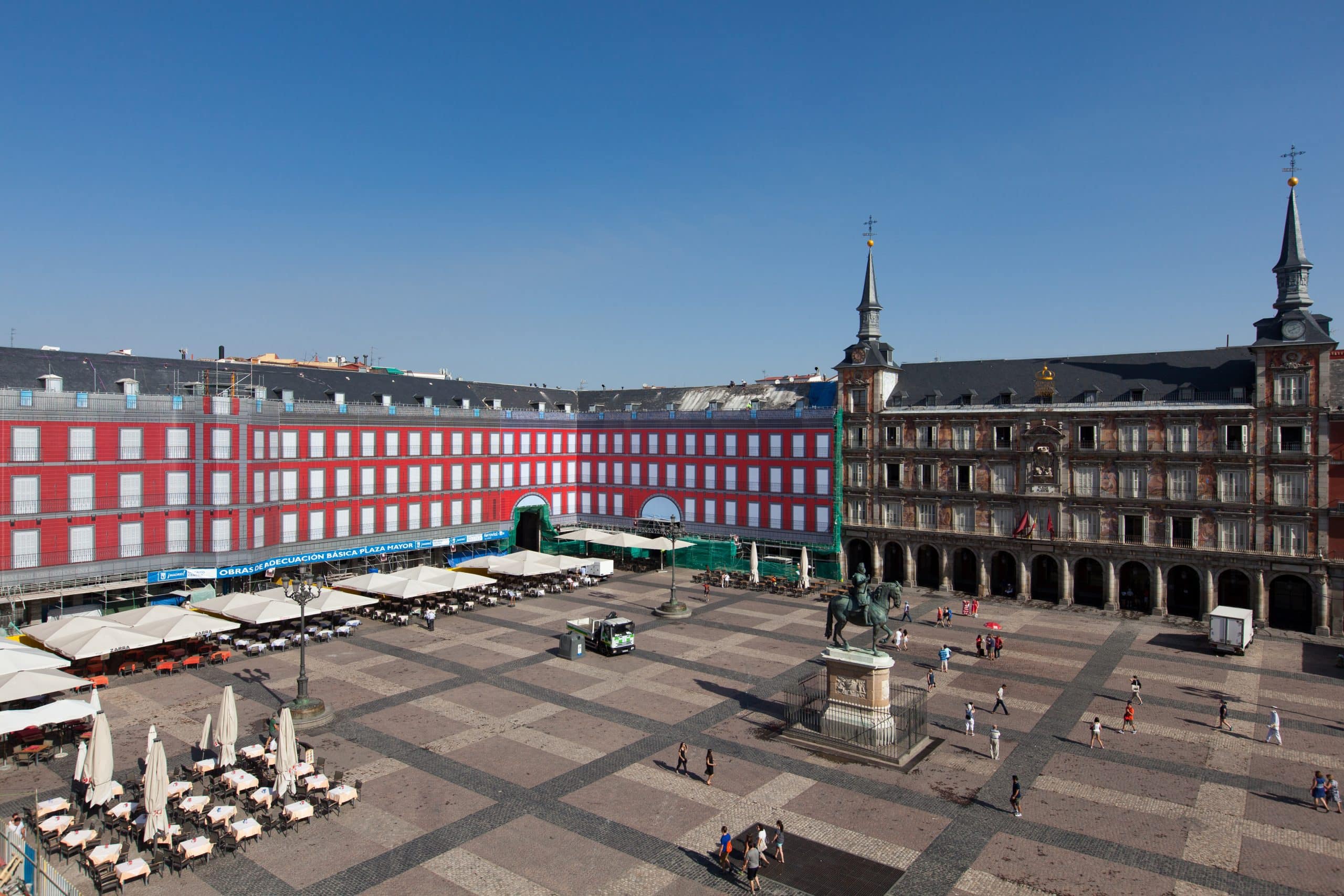
The architectural legacy of Juan de Villanueva, who reconstructed the Plaza Mayor following the 1790 fire, was defined by a specific residential intent. Villanueva lowered the building heights from five stories to three, not to prevent future infernos to create a habitable, breathable urban density. For over two centuries, this configuration supported a stable population of tradespeople, royal courtiers, and eventually, working-class Madrileños. Yet, the decade between 2010 and 2020 dismantled this residential continuity with a speed and ferocity that fire never achieved. The engine of this destruction was not combustion, the unregulated explosion of short-term rentals (STRs), which converted the historic fabric of the Plaza and its surrounding Centro district into a transient dormitory for global tourism.
Data from the Madrid City Council reveals a clear demographic during this period. In 2010, the Centro district, which encompasses the Plaza Mayor, Sol, and Palacio neighborhoods, housed 141, 236 registered residents. By 2019, that number had fallen to 132, 352, a loss of nearly 9, 000 permanent inhabitants in less than ten years. This aggregate decline masks a more disturbing trend: the erasure of families. The census recorded that the number of children under the age of five in the district dropped 5, 000 in 2011 and continued to slide, reaching a low of 3, 844 by 2019. Schools such as the Pi y Margall, located just minutes from the Plaza, reported families withdrawing students in the middle of academic terms because landlords refused lease renewals in favor of more lucrative tourist contracts.
The economic incentives driving this displacement were overwhelming. Between 2013 and 2019, rental prices in the Centro district surged by approximately 40% to 60%, depending on the specific barrio, while real estate portals like Idealista reported price-per-square-meter records that detached completely from local wage growth. Investors and multi-property owners capitalized on the "rent gap," evicting long-term tenants paying €800 a month to list the same units on platforms like Airbnb for €150 a night. By 2018, the "floating population", tourists and temporary visitors, in the Sol neighborhood (adjacent to Plaza Mayor) stood at 178% of the resident population. The Plaza itself, once a communal living room for locals, became a stage where residents were statistically outnumbered by their transient neighbors nearly two to one.
In response to this hollowing out, the administration of Mayor Manuela Carmena introduced the Plan Especial de Hospedaje (PEH) in 2018. This regulation attempted to curb the STR boom by requiring that any tourist apartment operating for more than 90 days a year must have an independent entrance from the street, a structural impossibility for the vast majority of the Plaza Mayor's 17th-century buildings. Under these rules, municipal inspectors estimated that 95% of the tourist rentals in the Centro district were operating illegally. Yet, enforcement proved to be a bureaucratic failure. The sheer volume of listings, exceeding 9, 000 in the central almond alone, overwhelmed the inspection teams. Platforms refused to remove non-compliant listings, and owners simply paid fines as a cost of doing business, continuing to operate in a legal gray zone that the city could not police.
The human cost of this transformation was the loss of the barrio identity. The 237 balconies overlooking the Plaza Mayor, designed by Villanueva to house citizens who would watch royal processions and autos-da-fé, largely ceased to function as residential amenities. Instead, they became premium viewing platforms for tourists. Residents who remained reported chronic sleep deprivation due to the noise of rolling suitcases on cobblestones at all hours, a sound that became the auditory symbol of the decade. The local commerce ecosystem also shifted; traditional grocers and hardware stores closed, replaced by luggage storage lockers, souvenir shops, and franchise eateries catering to the transient demographic.
The year 2020 marked a temporary, albeit violent, pause in this trajectory due to the COVID-19 pandemic. For a brief window, the "touristification" halted, and landlords attempted to return units to the long-term rental market. yet, the structural damage to the housing market had already been done. The table illustrates the correlation between the rise in tourism intensity and the decline of the local community in the Centro district during the serious pre-pandemic years.
| Year | Centro Population | Children (<5 Years) | Floating Pop. Ratio (Sol) | Est. Illegal Rentals |
|---|---|---|---|---|
| 2011 | 140, 500 (approx) | 4, 950 | 85% | <1, 000 |
| 2015 | 134, 800 | 4, 200 | 120% | ~4, 500 |
| 2019 | 132, 352 | 3, 844 | 178% | > 9, 000 |
By 2026, even with new attempts at regulation and a post-pandemic population rebound to nearly 149, 000, the nature of these new residents had changed. The district did not see a return of the working-class families displaced in the 2010s, rather an influx of wealthier, mobile professionals and digital nomads capable of paying the inflated rents established during the tourist boom. The Plaza Mayor of 2026 stands restored and vibrant, yet it functions less as a neighborhood square and more as a high-end consumption zone, fulfilling the commercial destiny that began with the displacement of its residents a decade prior.
Budget Allocation for the 2017 Quadricentennial Restoration
| Project Component | Source of Funds | Estimated Cost (EUR) | Primary Objective |
|---|---|---|---|
| Phase 1 General Restoration (2015-2017) | Public (Ayuntamiento) | 3, 280, 000 | Facades, slate roofs, waterproofing, arcades. |
| Casa de la Carnicería Rehabilitation | Private (Pestana Group) | 10, 500, 000 | Structural renovation for hotel conversion. |
| Casa de la Panadería Roofs | Public (Ayuntamiento) | 361, 000 | Emergency slate replacement and spire repair. |
| IV Centenario Cultural Program | Public (Ayuntamiento) | 2, 000, 000 | Events, art installations (e. g., Echelman net). |
| Monumental Lighting (LED) | Public (Ayuntamiento) | 350, 000 | Architectural highlighting and energy efficiency. |
| Tunnel Rehabilitation (2025) | Public (Ayuntamiento) | 862, 000 | Structural repair of underground service roads. |
The maintenance costs for the equestrian statue of Felipe III also appear in the ledger, though frequently buried within broader heritage conservation contracts. Following its declaration as a Bien de Interés Cultural (BIC) in 2017, the statue requires specialized bronze conservation. The removal of graffiti, a recurring expense, and the stabilization of the pedestal are funded through the city's monuments budget. The 2017 designation provided a legal framework to enforce stricter penalties for vandalism, theoretically reducing the long-term cleanup costs, though the effectiveness of this deterrent remains debatable given the plaza's high traffic. Storm Filomena in January 2021 provided a stress test for the 2017 investments. The heavy snow load threatened the newly restored slate roofs and tested the waterproofing of the arcades. While the major structures held, the freeze-thaw pattern wreaked havoc on the paving, necessitating further repairs that bled into the 2022 and 2023 maintenance budgets. This pattern of damage and repair highlights the Sisyphus-like nature of funding the Plaza Mayor: the city pours millions into stone and slate, yet the elements and the crowds relentlessly the investment. The 2017 budget also marked a shift in how the city views the plaza's return on investment. By heavily subsidizing the aesthetic restoration while outsourcing the functional occupancy of the Casa de la Carnicería, the administration acknowledged that the Plaza Mayor is no longer just a civic space; it is a commercial engine. The 10. 5 million euro private investment serves as the anchor, ensuring that at least one side of the square generates tax revenue to offset the public maintenance bill. This public-private dichotomy defines the modern financial existence of the plaza, a far cry from the royal coffers that funded the 1617 construction or the 1790 reconstruction. Today, the survival of Juan de Villanueva's masterpiece depends as much on hotel occupancy rates as it does on municipal tax receipts. Looking toward 2026, the financial planning continues to evolve. The completion of the tunnel works aims to secure the plaza's foundation, new challenges loom. The "Southwest Green Promenade" and other 2026 urban projects compete for the same infrastructure funds. The Plaza Mayor must fight for its share of the pie, justifying its expense not by its history, by its ability to attract the millions of tourists who feed the city's economy. The 2017 restoration was a necessary stopgap, a multi-million euro bandage applied to a four-century-old patient that requires constant, expensive care to remain the heart of Madrid.
Commercial Homogenization and Traditional Business Closures

Commercial Shift Indicators (2010, 2026)
| Metric | 2010 Status | 2026 Status |
|---|---|---|
| Primary Retail Type | Philately, Numismatics, Textiles | Souvenirs, Fast Food, Franchises |
| Avg. Commercial Rent | Protected (Old Rent) | Market Rate (€10, 000+ / month) |
| Squid Sandwich Price | €2. 70 | €4. 30, €4. 50 |
| Residential Cost | ~€3, 500/m² (Purchase) | ~€6, 793/m² (Purchase) |
The Sunday stamp and coin market, a tradition dating back to 1927, survives largely as a relic. While the outdoor stalls remain, the permanent philately shops that anchored the trade during the week have largely, replaced by businesses that can monetize the 10 million tourists passing through the square annually. The specialized knowledge required to run a numismatic shop cannot generate the revenue per square meter achieved by selling frozen calamari or sangria in plastic pitchers. Real estate pressure has also purged the residential population above the arcades. The upper floors, designed by Villanueva to house merchants and civil servants, have been converted into short-term rental units. By 2026, purchase prices for apartments in the Plaza Mayor reached an average of €6, 793 per square meter, a figure that excludes the majority of the local working population. The result is a "hollow" square: the balconies are full, the lights are rarely on for more than three days at a time. The Plaza Mayor has ceased to be a neighborhood and has become a dormitory for transients, serviced by a commercial that extracts value from their presence while offering nothing to the city's permanent residents.
Surface Temperature Analysis and Heat Mitigation Failures 2024
| Location | Surface Material | Condition | Peak Surface Temp (°C) | Air Temp at 1. 5m (°C) | Thermal Comfort Status |
|---|---|---|---|---|---|
| Plaza Mayor (Center) | Grey Granite | Direct Sun | 63. 5°C | 39. 8°C | Severe Heat Stress |
| Plaza Mayor (Arcade) | Stone/Concrete | Deep Shade | 34. 2°C | 38. 5°C | Moderate Discomfort |
| Plaza de Santa Ana | Compacted Soil/Tree Root | Tree Shade | 33. 1°C | 37. 9°C | Tolerable |
| Puerta del Sol | Granite/Concrete | Direct Sun | 54. 8°C | 39. 9°C | Severe Heat Stress |
| Plaza de Callao | Dark Stone | Direct Sun | 65. 0°C | 40. 1°C | serious Danger |
The 63. 5°C reading in Plaza Mayor is particularly damning because of the albedo effect. The grey granite used in the 2017 renovation was selected for durability and aesthetics, yet its thermal properties were insufficiently tested against extreme heat scenarios. While lighter than asphalt, the stone still absorbs a significant amount of solar energy. More serious, the absence of permeability means there is no evapotranspiration. Rainwater, when it does fall, is immediately drained away into the sewer system rather than being absorbed by the ground to provide later cooling. The square functions as a waterproof lid, rejecting any natural cooling pattern. Health statistics from the summer of 2024 correlate with these physical measurements. Emergency services reported a spike in heat-related interventions in the Centro district, with tourists frequently collapsing from heat exhaustion within the perimeter of the historic quarter. The "frying pan" effect of the Plaza Mayor meant that emergency vehicles had to navigate a thermal hazard zone. The radiant heat coming off the ground was high enough to soften the rubber soles of shoes and cause burns to skin in contact with the stone for more than a few seconds. The economic impact of this heat failure also became clear in 2024. Business owners operating the terraces (terrazas) reported a sharp decline in midday patronage. The traditional lunch hour, once a peak time for the plaza's restaurants, became a dead zone. Patrons refused to sit outside, even under umbrellas, because the heat radiating from the granite floor created an oven-like effect that trapped hot air under the canvas. The economic activity of the square was forced into a nocturnal pattern, yet the retained heat in the stone meant that the plaza remained uncomfortably warm well past midnight. Urban planning experts that the 2024 emergency was not an accident a design choice. The decision to maintain the Plaza Mayor as a ceremonial stage rather than a living climate refuge ignores the shifting atmospheric reality. The "mineralization" of Madrid's public spaces, a trend seen in the renovations of Puerta del Sol and Plaza de España, has prioritized low-maintenance hardscapes over biological complexity. In Plaza Mayor, this method has reached its logical, uninhabitable conclusion. The underground parking garage remains the silent killer of the square's chance, a concrete barrier that prevents the one solution, large canopy trees, that could lower surface temperatures by the necessary 15 to 20 degrees. Until the city addresses the subterranean constraints or challenges the rigid interpretation of heritage laws, the Plaza Mayor remain a monument to the climate blindness of the 21st century.
Overcrowding Metrics and Pedestrian Flow Restrictions 2025
By December 2025, the Plaza Mayor ceased to function as a public square and operated instead as a high-security containment zone. The Municipal Police of Madrid activated "Nivel Negro" (Black Level) on twelve separate occasions between November 22, 2025, and January 6, 2026, a record frequency that paralyzed the historic center. This police designation indicates absolute saturation, requiring the immediate closure of all access points and the suspension of Metro and Cercanías stops at Sol to prevent feeding more bodies into the crush. The metrics driving these decisions reveal a mathematical conflict between 18th-century containment architecture and 21st-century mass tourism.
The structural root of this congestion lies in the reconstruction ordered after the 1790 fire. Architect Juan de Villanueva, tasked with fireproofing the square, sealed the previously open corners to prevent drafts that had fanned the flames. He connected the facades with heavy masonry arches, turning the plaza into a hermetic. While this design succeeded in containing fire, it created a dangerous hydraulic problem for pedestrian flow. In 2025, the ten access arches, specifically the Arco de Cuchilleros and the Arco de Toledo, acted as valves that could not cope with the pressure of 40, 000 simultaneous visitors. The Cuchilleros exit, with its steep, narrow staircase, became a primary choke point, forcing police to implement strict one-way pedestrian traffic systems to avoid stampedes.
Data collected by the Integrated Security Center (CISEM) during the 2025 Christmas campaign shows the severity of the density. On December 6, 2025, sensors recorded peak densities of 5. 8 persons per square meter near the statue of Philip III. At this density, individual movement becomes impossible, and the crowd moves as a fluid mass, a phenomenon known as "turbulence" in crowd. To manage this, the City Council deployed AI-driven counting systems at every archway. These cameras provided real-time headcounts, triggering automated closures when the interior population exceeded 22, 500 people, a safety cap established to ensure emergency vehicle access.
The following table contrasts the historical capacity of the Plaza Mayor with the regulated limits of the modern era, illustrating the shift from static spectatorship to, hazardous flow.
| Era | Primary Usage | Estimated Capacity | Flow |
|---|---|---|---|
| 1700s | Royal Bullfights / Autos-da-fé | 50, 000 (Static) | Spectators confined to balconies and stands; ground level controlled. |
| 1980s | Concerts / General Transit | 35, 000 (Mixed) | Unregulated entry; high risk during egress. |
| 2025 | Mass Tourism / Christmas Market | 22, 500 (Capped) | flow; constant friction between entering and exiting groups. |
The "Operación Navidad" for the 2025-2026 season introduced the most aggressive pedestrian restrictions in Madrid's history. Police enforced a mandatory single-direction circuit: pedestrians could only enter via Calle Mayor and Calle de la Sal, while exits were forced through Calle de Atocha and Calle de Toledo. This militarization of walking routes aimed to prevent the "counter-flow" collisions that cause falls and panic. Yet, the friction was exacerbated by the commercial occupation of the square. In 2025, licensed terraces (terrazas) and the 104 stalls of the Christmas market occupied 38% of the usable surface area. This commercial encroachment reduced the walking space to a series of narrow corridors, artificially inflating the density metrics even when the total headcount was the maximum limit.
Surveillance technology played a central role in enforcing these mandates. The Municipal Police Air Support Unit deployed drones equipped with thermal imaging and loudspeakers to monitor the "blind spots" behind the market stalls. These drones, hovering at 50 meters, broadcasted instructions to disperse crowds that lingered too long in the center. This auditory bombardment, combined with the visual presence of riot police at the arches, transformed the visitor experience from leisure to processed compliance. The data from 2025 indicates that the average dwell time, the time a visitor spends in the square, dropped to 18 minutes, down from 45 minutes in 2015. The plaza is no longer a place to stay; it is a machine for processing human movement.
The displacement of local residents is the silent metric accompanying this saturation. In the Centro district, the registered residential population continued its decline, dropping 130, 000 in 2025. The residential units within the Plaza Mayor itself, once prestigious addresses, are predominantly short-term rentals or empty shells held by investment firms. The noise pollution levels during the "Black Level" alerts frequently exceeded 85 decibels, rendering the few remaining inhabited apartments unlivable. The 2025 saturation report suggests that without a reduction in commercial licenses, the plaza become purely a transit hub, devoid of any organic civic life.
Looking toward 2026, the City Council has proposed installing permanent turnstiles at the arches, a measure that would finalize the transformation of the Plaza Mayor from a public thoroughfare into a gated venue. This proposal admits a failure of urban planning: the architecture of Juan de Villanueva, designed to keep fire in, struggles to keep people out. The square has become a victim of its own magnetism, a historic vacuum that pulls in more bodies than its stone geometry can safely hold.
Organized Pickpocketing Syndicates and Surveillance Grid 2026
By early 2026, the security in Madrid's Centro district shifted toward a high-friction conflict between entrenched criminal groups and an expanding digital dragnet. Police data from 2025 records 1, 564 interventions in the central district alone, the highest figure in the capital. This surge reflects the persistent activity of organized theft rings, including the notorious "Clan de las Bosnias" and other groups that commute daily from peripheral towns like Torrejón de Ardoz. These syndicates operate with military precision in Plaza Mayor; scouts mark tourists while "picar" specialists extract wallets, frequently passing the stolen goods to a third member to evade immediate detection if stopped.
City officials responded to this density of theft by hardening the surveillance infrastructure. As of January 2026, the municipal video network grew to over 400 cameras, with specific installations targeting high-traffic zones like Plaza del Dos de Mayo and the streets feeding into Plaza Mayor. The new hardware includes Artificial Intelligence capabilities that allow operators to search recorded footage for specific visual traits, such as clothing colors or physical descriptions, reducing the time needed to locate suspects. This technology supports the "Patrulla Madrid" citizen groups and uniformed officers who conduct raids, such as the February 2026 operation that checked nearly 1, 200 individuals across the region to disrupt these commuter crime rings.
The syndicates have adapted to this digital pressure by altering their tactics. Intelligence reports show that pickpockets use counter-surveillance methods, identifying camera blind spots and changing clothes multiple times a day to confuse the AI tracking systems. The confrontation has escalated beyond stealth; repeat offenders, aware of the legal limits on detention for non-violent theft, have become more aggressive when cornered by residents or police. This cat-and-mouse game defines the Plaza Mayor experience in 2026, where historic cobblestones are the stage for a modern battle between algorithmic policing and organized, resilient criminal networks.
The 2026 Pavement Rehabilitation and Terrace Reordering Plan
The following table outlines the evolution of the Plaza Mayor's surface composition and primary utility from its inception to the 2026 rehabilitation.
| Time Period | Surface Material | Primary Function | Infrastructure Context |
|---|---|---|---|
| 1619, 1848 | Compacted Earth / Sand | Spectacle (Bullfights, Executions) | Natural ground, permeable surface. |
| 1848, 1936 | Landscaped Gardens / Dirt route | Leisure (Bourgeois Promenade) | Installation of fountains and trees (Isabel II). |
| 1936, 1967 | Cobblestone / Asphalt | Transit (Trams, Vehicular Traffic) | Gardens removed for circulation efficiency. |
| 1967, 1969 | Excavation Site | Construction | Total removal of subsoil for parking garage. |
| 1969, 2016 | Granite Slabs | Pedestrian / Commercial | Artificial surface resting on concrete pillars. |
| 2026, Future | Waterproofed Granite / Smooth route | Tourism / Regulated Hospitality | Structural reinforcement of underground beams. |
The 2026 rehabilitation is an admission that the Plaza Mayor is no longer a simple open space. It is a complex, multi-level machine that requires industrial-grade maintenance. The leaks into the parking lot are a symptom of the disconnect between the surface's historic image and its modern engineering reality. The granite stones are not resting on Spanish earth; they are floating on a failing membrane above a subterranean highway. The enforcement of the terrace ordinance signals a shift in governance. The City Council has prioritized the "visual integrity" of the monument over the maximization of commercial square footage. This suggests a future where the Plaza Mayor is treated more like a museum gallery, curated, temperature-controlled, and strictly regulated, than a chaotic town square. The residents, protected by the Plan Reside outnumbered by the daily influx of visitors, watch these works from their balconies. They see the lifting of the stones not as a restoration of the past, as a desperate attempt to keep the 20th-century concrete from collapsing under the weight of the 21st-century tourism economy. The fire of 1790 destroyed the wood; the water of 2026 threatens the concrete. The Plaza survives, as it always has, by adapting its skin to the needs of the power that controls it.